Search my blog

Custom Search

Contact me

koolraj003@gmail.com

Saturday, November 28, 2009

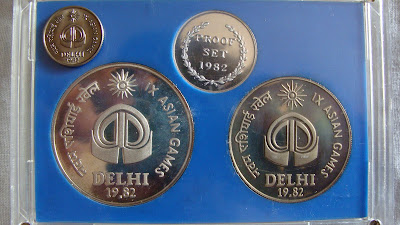
Proof set: Asian games

Cover
asian games 1982 proof set coverObverse
asian games proof set obverseReverse
asian games proof set reverse10 rupee obverse
asian games 10 rupee obverse10 rupee reverse
asian games 10 rupee reverse100 rupee obverse
asian games 100 rupee obverse100 rupee reverse
asian games 100 rupee reverse
The 9th Asian Games were held from November 19, 1982 to December 4, 1982 in Delhi, India. This was the second time the Games were held in Delhi as it was also host to the inaugural 1951 Asian Games. New Delhi joined Bangkok (four times) as the only cities to host multiple editions of the Asian Games.

The Delhi Asian Games was the first Asiad to be held under the aegis of the Olympic Council of Asia (OCA). The Asian Games Federation, under whose jurisdiction the first eight Asian Games had been held, dissolved to make way for the OCA.

A total number of 4,595 athletes, coming from 33 countries, competed in this Asiad. Debut sports were equestrian, golf, handball, rowing, and Women's field hockey.

These Asian Games also saw the beginning of Chinese dominance in the medals tally. Japan had won the most number of medals in previous editions of the Games. China made its presence felt in the sporting world by dethroning Japan as the top gold medalists.

In preparation for the IX Asian Games, colour television was introduced in India in a big way, as the Games were to be broadcast in colour.

The mascot for the Games was Appu – a kid elephant. Known in real life as "Kuttinarayanan", this elephant fractured its leg in an accident when he was seven years old – he stepped into a septic tank. That wound would not heal and it eventually killed him. Kuttinarayanan died on May 14, 2005.

Host of the next (10th) Asiad in 1986, and the 24th Summer Olympics in 1988, South Korea participated in the New Delhi Asiad with a 406-person delegation, including an observation team to study the facilities, management and events.


bombay mint mark
The mint mark 'B' below the date shows that this is a proof coin minted in the Bombay mint.

Thursday, November 26, 2009

UNC set: national integration

Cover
national integration 1982 coverObverse
national integration unc set obverseReverse
national integration unc set reverse10 rupee (copper-nickel) obverse
national integration 10 rupee obverse10 rupee reverse
national integration 10 rupee reverse100 rupee obverse
national integration 100 rupees obverse100 rupee reverse
national integration 100 rupee reverse

Tuesday, November 24, 2009

UNC set: SBI

Cover
sbi coverObverse
sbi unc set obverseReverse
sbi unc set reverse5 rupee copper-nickel
sbi 5 rupee copper nickel100 rupee obverse
sbi 100 rupee obverse100 rupee reverse

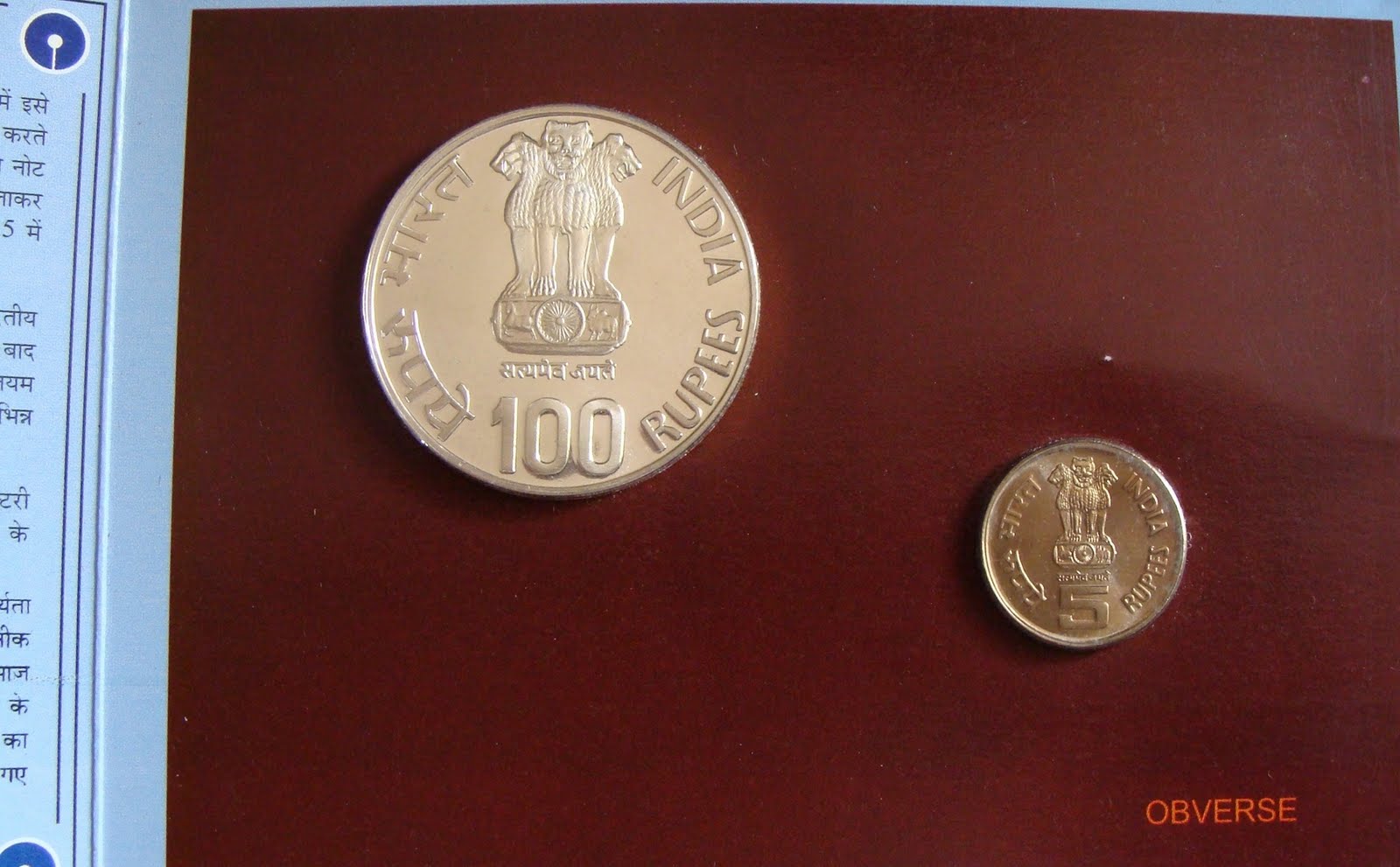
sbi 100 rupee reverseState Bank of India (SBI) is the largest bank in India.

The bank traces its ancestry back through the Imperial Bank of India to the founding in 1806 of the Bank of Calcutta, making it the oldest commercial bank in the Indian Subcontinent. The Government of India nationalised the Imperial Bank of India in 1955, with the Reserve Bank of India taking a 60% stake, and renamed it the State Bank of India. In 2008, the Government took over the stake held by the Reserve Bank of India.

SBI provides a range of banking products through its vast network in India and overseas, including products aimed at NRIs. The State Bank Group, with over 16000 branches, has the largest branch network in India. With an asset base of $250 billion and $195 billion in deposits, it is a regional banking behemoth. It has a market share among Indian commercial banks of about 20% in deposits and advances, and SBI accounts for almost one-fifth of the nation’s loans.

SBI has tried to reduce its over-staffing through computerizing operations and Golden handshake schemes that led to a flight of its best and brightest managers. These managers took the retirement allowances and then went on the become senior managers at new private sector banks.

The State bank of India is 29th most reputable company in the world according to Forbes.

Sunday, November 22, 2009

Proof set: First war of independence

Cover
first war of independence coverObverse

first war of independence obverseReverse
first war of independence reverse5 rupee copper nickel
first war independence 5 rupee copper-nickel100 rupee obverse
100 rupee 150 years first war of independence100 rupee reverse
100 rupee 150 years first war of independence reverse

This set was released on the completion of 150 years of the first war of independence. The reverse shows two persons firing a cannon at the bottom and some warriors on horseback flanked by the figures of Bahadur Shah Zafar on the right and Tatya Tope on the left, who were two cogs in the wheel of the war. Bahadur Shah zafar was the last Mughal emperor. He was the ruler of Delhi and was also the weakest link in the revolt. The East India company made its arrival in India during the reign of the Mughal emperor Jahangir at around 1616 AD. They came originally as traders, but slowly and steadily kept expanding their reach and influence. Their aspirations and desires grew in India and one by one, they started to take over different princely states and sultanates by agreement, by deceit, and also by conquest. Many states were taken over through the doctrine of lapse, which stated that any adopted heir was not recognised as a legal heir, and the rulers like rani Laxmi Bai of Jhansi thought of this as an interference in the traditional inheritance policy. Unrest grew among the princely states as one by one the British were usurping power from the princes. Most of the practices followed by the British were also not acceptable to the strictly religious Indians. One such practice was the supposed use of pork and beef in bullet cartridges in the enfield rifles that were being given to the Indian sepoys employed by the British. Pork is taboo for Muslims and beef is anathema for Hindus. So Muslims and Hindus both were agitated by the British rule and practices. In march 1857, Mangal Pandey refused to use the enfield rifles that were provided to them and this was the trigger in the outbreak of the revolt, the seeds of which had been fomenting for quite a time. One by one, the different states declared war on the British during that year only. Eminent leaders in the war for independence from British rule included rani Laxmi Bai of Jhansi, Tatia Tope, Bahadur Shah Zafar, Tipu Sultan, Rani Chennamma, begum Hazrat Mahal, Nana Saheb Peshwa and the 80 year old Kunwar Singh of Bihar. Most of the revolt was on the part of the aristocracy who were highly insecure because of their reign being taken over by the British. The participation on the part of the zamindars, taluqdars and the peasantry was very limited.

Mangal Pandey's fellow regiment men refused to arrest him, but he was unable to incite an open rebellion on their part. He tried to fire himself with his musket for his failure, but only wounded himself. He was later court martialled and hanged. The fallback of the rebellion started by Mangal Pandey was that it was not organized revolt, everyone declared war one by one. Had the revolt broken out in a coordinated manner, the British would have had their hands full. Another reason for the failure of the revolt was the non-participation of the sikhs and the pathans of North West Frontier Province and Punjab. Most people believe that this was because earlier the British had annexed Punjab only because the British had got inside help from Purbias(Bengalis and Marathis- Easterner), and the sepoys were despised far more than the British by these communities at that time.

So as a foregone conclusion, the revolt was crushed and every involved person had to face dire consequences. A no prisoner policy was adopted and mass executions were carried out with muskets , and also a large number of people were bound to cannons and blown to bits, like the Namdhari Sikhs. Bahadur shah Zafar was exiled to Rangoon where he died later. Many leaders were blown by cannons, and there was large scale massacre. Women were spared but the men and the children were heartlessly killed. And I am talking of civilians , who did not take part in the revolt. Shockingly, the brutal aftermath of the reconquest was approved and also lauded of back in England as some accounts said the orientals had done wrong to the Europeans there , and that several young European girls were raped by them. Still , some people in the British army themselves did not approve of the inhuman and savage acts of suppression. People like Karl Marx have pointed out that the accounts of Indians acting as uncivilized and brutal people were biased , and in some cases, the person giving the account was not even present at the mentioned event.

The conclusion of the revolt of 1857 was that there was mass, brutal suppression and the Crown of England, at that time Queen Victoria took over the reins of colonial domination, and she became Empress Victoria.

The mint mark 'M' below the date indicates that this coin is a proof coin and struck in the Mumbai mint.

Friday, November 20, 2009

UNC set: ONGC

cover
ongc unc set coverobverse
ongc unc set obversereverse
ongc unc set reverse5 rupee copper-nickel
ongc 5 rupee copper nickelONGC 50 rupee obverse
ongc 50 rupees obverse50 rupee reverse
ongc 50rupees reverse
Oil and natural gas corporation (ONGC) is one of Asia's largest and most active companies involved in exploration and production of oil. It is involved in exploring for and exploiting hydrocarbons in 26 sedimentary basins of India. It produces about 30% of India's crude oil requirement. It owns and operates more than 11,000 kilometres of pipelines in India. Until recently (March 2007) it was the largest company in terms of market cap in India.

ONGC is considered Asia's best Oil & Gas company . It ranks as the 2nd biggest E&P company (and 1st in terms of profits), as per the Platts Energy Business Technology (EBT) Survey 2004. It ranks 24th among Global Energy Companies by Market Capitalization in PFC Energy 50 (December 2004).

Wednesday, November 18, 2009

UNC set: dandi march

Cover
dandi march coverObverse
dandi march obverseReverse
dandi march reverse5 rupee copper nickel
5 rupee dandi march copper nickel100 rupee : 50% silver
100 rupee dandi march obverse
100 rupee reverse
dandi march 100rupees reverse
This set was minted in the commemoration of the completion of 75 years of dandi march.It depicts the event of Dandi march. The British had imposed a tax on salt, and Gandhi decided to do a salt satayagrah, which took place in 1930.

The Salt Satyagraha was a campaign of non-violent protest against the British salt tax in colonial India which began with the Salt March to Dandi on March 12, 1930. It was the first act of organized opposition to British rule after Purna Swaraj, the declaration of independence by the Indian National Congress. Mahatma Gandhi led the Dandi march from his Sabarmati Ashram to Dandi, Gujarat to make salt tax free, with growing numbers of Indians joining him along the way. When Gandhi broke the salt laws in Dandi at the conclusion of the march on April 6, 1930, it sparked large scale acts of civil disobedience against the British Raj salt laws by millions of Indians. This event was very significant in India's struggle for independence.

The image shown on the coin's obverse, the Dandi March ,is from an original rare photograph also shown on the cover of the set.There was also a 50 paise coin on dandi march, released in 1997. the picture shown on it has been immortalized in various places as a statue, or rather a series of statues of Mahatma Gandhi and his followers.

Friday, November 13, 2009

Indian 25 paise : commemorative

25 paise: world food day


25 paise: forestry for development
The reverse reads vikas ke liye vaniki at the top in Hindi, which means forestry for development. This one is a particularly hard to find small commemorative coin. Its like 1 coin in a lot 400-500 25 paise coins, maybe even lesser. I like this coin the most in Indian commemoratives.


25 paise: rural women's advancement
25 paise rural women's advancementThe rural women's advancement 25 paise coin is supposed to be common and very easy to find as the Krause catalog states its total mintage to be around 34 million, which is way higher than even asian games 25 paise coin which had a mintage of about 24 million and is very easily found; but I have been able to find just 2 pieces of this item, that too in XF condition. This one I got from a lot of large number of 25 paise coins a coin seller had. The star below the date shows that this this coin was minted in the Hyderabad mint.

See also: Rural women's advancement proof set


25 paise : Asian games
25 paise asian games
The 9th Asian Games were held from November 19, 1982 to December 4, 1982 in Delhi, India. This was the second time the Games were held in Delhi as it was also host to the inaugural 1951 Asian Games. New Delhi joined Bangkok (four times) as the only cities to host multiple editions of the Asian Games.

The Delhi Asian Games was the first Asiad to be held under the aegis of the Olympic Council of Asia (OCA). The Asian Games Federation, under whose jurisdiction the first eight Asian Games had been held, dissolved to make way for the OCA.

A total number of 4,595 athletes, coming from 33 countries, competed in this Asiad. Debut sports were equestrian, golf, handball, rowing, and Women's field hockey.

These Asian Games also saw the beginning of Chinese dominance in the medals tally. Japan had won the most number of medals in previous editions of the Games. China made its presence felt in the sporting world by dethroning Japan as the top gold medalists.

In preparation for the IX Asian Games, colour television was introduced in India in a big way, as the Games were to be broadcast in colour.

The mascot for the Games was Appu – a kid elephant. Known in real life as "Kuttinarayanan", this elephant fractured its leg in an accident when he was seven years old – he stepped into a septic tank. That wound would not heal and it eventually killed him. Kuttinarayanan died on May 14, 2005.

Host of the next (10th) Asiad in 1986, and the 24th Summer Olympics in 1988, South Korea participated in the New Delhi Asiad with a 406-person delegation, including an observation team to study the facilities, management and events.

See also: Asian games proof set

Monday, November 9, 2009

Indian 25 paise

25 paise 1984
25 paise 1984
25 paise, 1985
25 paise ottawa mint 1985Metal: copper-nickel


25 paise, 1998
25 paise rhino 1998The reverse shows the Indian one-horned rhinoceros, once found in large numbers but now reduced to only a few thousand because of poaching for its horn, which has its uses as a medicine.

Destruction of their habitat over the years, has brought the rhinos to the brink of extinction. These animals are among the worlds' most endangered species. The great one-horned rhino could once be found from Pakistan all the way through India, Nepal, Bangladesh, Bhutan and Myanmar. By the turn of the century, this species had vanished from much of its range, and today only about 2500 survive in India and Nepal. Throughout their range, their habitat continues to dwindle fast due to conversion of grassland habitats into agricultural fields and other human pressures. The threat of poaching continues to be ever-present.


25 paise, 1963
25 paise 1963Metal: nickel
Diameter: 19mm
Reverse: "rupaye ka chautha bhag" meaning fourth part of a rupee; and 25 'naye paise' meaning new paise
Obverse: lion capital from Ashoka pillar

Thursday, November 5, 2009

Indian Bull anna

Half anna, 1950

One anna, 1950
one anna 1950 bull zebu
2 anna , 1950
two anna 1950 bullCirclated for a short time in the 1950s, the anna series of republic India had a bull on all the anna coins, and I still haven't been able to figure out why the bull features on them, I believe the bull is probably from the seal found at Mohenjodaro and Harappa, though it could also be there because most of our population was involved in agriculture where the bull plays an important role, in ploughing and all. The animal featuring on the anna series is called a Zebu. The zebu has been used extensively in India as a riding and draft animal. It has different subspecies and it is found in large and extensive regions of South Asia and also Africa.

The anna series was replaced by the paisa series and the naye paise. 100 naye paise were now equal to one rupee. Earlier, 16 paise made one anna and 16 annas made one rupee, with the coming of the naye paise system, the anna system became obsolete. The naye paise came to be called simply paise.

Note: Before India became a republic, and after the independence, some tokens called jain tokens were circulated to some extent as one anna and two anna coins in 1947. They had the same shape and as those of one anna and two anna shown above.