Search my blog

Custom Search

For sale

1. iowa/arkansas/ texas/wisconsin state quarter
2.1877 1/2 anna XF-
3.50 years independence unc set
4.Gandhi 10rs
5. unity in diversity(cross) 5 rupees
6.Edward 1/12 anna 1905 UNC
7.1970 1 rupee
8.George V 2 anna AU
9.2004 2rs


If condition is not mentioned then take it to be perfect.

Contact me: koolraj003@gmail.com

"An unidentified coin is a piece of metal. But an identified coin is a piece of history."

"Great collections are built not on money but on passion"

"I can only show you the path. It is you who has to walk on it."

"Collections are not measured in quantity or items you have but in quality and by items missing in collection"

Thursday, April 29, 2010

USA nickel - I

Ocean in view nickel, 2005
usa ocean in view nickel 2005 5 cent
The Lewis and Clark expedition was a two year journey(1804-1806) which was the first overland expedition to the Pacific Coast and back. It was led by Meriwether Lewis and William Clark, and was assisted by the Shoshone woman Sacagaewa and her French-Canadian explorer husband, Touissant Charbonneau. The expedition helped to assess accurately the resources being exchanged in the Louisiana purchase and laid much of the groundwork for the Westward expansion.

Achievements of the expedition:
1)Better knowledge of the Geography of the region with about 140 maps being made
2)Better understanding of the flora and fauna
3)Improvement of relations with Indians.

The obverse of this coin shows a modernized depiction of Thomas Jefferson, and the reverse shows a depiction of the Pacific Ocean as seen by William Clark in 1805. Clark had written in his diary: "Ocian in view! O! The joy!", but the mint thought that this spelling of ocean would be perceived to be an error and would cause lot of hoarding. So the spelling was changed from ocian to ocean..


Monticello/Jefferson nickel, 2008
usa monticello thomas jefferson nickel 2008
From 2006 onwards, the nickel shows a forward facing Jefferson, based on the 1800 Rembrandt Peale painting of Jefferson. The reverse feaatures the Monticello, Jefferson's Virginia estate. This is the first circulation coin in the US featuring a forward facing former president.


Jefferson nickel,1980
usa 5 cent nickel 1980 thomas jefferson
The Jefferson nickel has been in circulation in USA for the longest period of time(1939-2003). It features the bust of Thomas Jefferson(taken from Houdon's marble bust of 1789) on the obverse, and his Virginia estate Monticello on the reverse.

Tuesday, April 27, 2010

USA silver dollar

Morgan dollar, 1921
usa morgan dollar 1921
usa morgan dollar 1921The Morgan dollar was named so after its designer, George T. Morgan. It was minted from 1878 to 1904, and then in 1921.


Peace dollar, 1922
usa peace dollar 1922 eagle
usa peace dollar 1922
On the ending of the first world war , a commemorative coin was proposed to be minted for the end of the war. Instead, the peace dollar was issued as a circulating coin. It is so called because the word peace is written on the bottom of the reverse of the coin. It was minted from 1921 to 1928, and then again in 1934 and 1935.

These coins have a mass of 26.73gm and 90% of which is silver. The size is 39mm diameter. So they would be worth at least 600-700 rupees on metal value alone.

Sunday, April 25, 2010

USA dollar

Sacagaewa dollar, 2000
usa sacagaewa dollar 2000
The Sacagawea dollar, called by the U.S. Mint the Sacagawea Golden Dollar Coin and beginning in 2009 the Native American $1 Coin, along with the Presidential Dollar series, is one of the two current United States dollar coins. This coin was first minted by the United States Mint in 2000 and depicts the Shoshone woman Sacagawea, a member of the Lewis and Clark Expedition, carrying her son Jean Baptiste Charbonneau. The coin's artist, Glenna Goodacre, used a 22-year-old Shoshone woman named Randy'L He-dow Teton as the model for the young Sacagawea. The Sacagaewa dollars of 2009 and 2010 have different designs on the reverse than the one shown here.


Susan B. Anthony dollar, 1979
usa susan anthony dollar 1979The Susan B. Anthony dollar replaced the excessively large Eisenhower dollar in circulation. It shows women suffrage campaigner Susan B. Anthony on the obverse and the Apollo 11 insignia on the reverse, the same as on the Eisenhower dollar. It is quite easy to collect as it has very large mintages. It was minted from 1979 to 1981, and later on in 1999 also. It is a rounded coin though it looks like an 11-sided one. Due to similar size and color, this one is sometimes referred to as the Susan Anthony quarter because of its small size which is similar to a quarter.

More than 888 million Susan Anthony dollars were minted in 1979, but they failed to circulate well. At the end of the year there were millions of dollars still left in the mint's vaults. Limited quantity was produced thereafter in 1980 and in 1981, these dollars were produced as UNC sets, of which a large number were broken down. After a very long hiatus, this dollar coin was reproduced in 1999 as the dollars in circulation were nearly finished. It was replaced by the Sacagaewa in 2000.

Friday, April 23, 2010

USA Eisenhower dollar

Liberty bell, Philadelphia
liberty bell
Eisenhower bicentennial dollar, 1976
usa eisenhower bicentennial dollar 1976
usa eisenhower bicentennial dollar liberty bell
Released on the bicentennial of the independence of the USA i.e. in 1976, this dollar has president Eisenhower on the obverse and the liberty bell and moon on the reverse.

Tradition tells of a chime that changed the world on July 8, 1776, with the Liberty Bell ringing out from the tower of Independence Hall summoning the citizens of Philadelphia to hear the first public reading of the Declaration of Independence by Colonel John Nixon.

The Pennsylvania Assembly ordered the Bell in 1751 to commemorate the 50-year anniversary of William Penn's 1701 Charter of Privileges, Pennsylvania's original Constitution. It speaks of the rights and freedoms valued by people the world over. Particularly forward thinking were Penn's ideas on religious freedom, his liberal stance on Native American rights, and his inclusion of citizens in enacting laws.

The Liberty Bell gained iconic importance when abolitionists in their efforts to put an end to slavery throughout America adopted it as a symbol.

There is widespread disagreement about when the first crack appeared on the Bell. Hair-line cracks on bells were bored out to prevent expansion. However, it is agreed that the final expansion of the crack which rendered the Bell unringable was on Washington's Birthday in 1846.

The bell had also been rung to announce the opening of the First Continental Congress in 1774 and after the Battle of Lexington and Concord in 1775.

The Liberty Bell was known as the "Independence Bell" or the "Old Yankee's Bell" until 1837, when it was adopted by the American Anti-Slavery Society as a symbol of the abolitionist movement.


Eisenhower dollar, 1978
usa eisenhower dollar 1978
usa eisenhower dollar eagleThe Eisenhower 1 dollar was minted for an 8 year period from 1971-1978 and is named for president Dwight David Eisenhower, who appears on the obverse. It followed the Peace dollar program and was the last dollar in circulation to have a proportional amount of base metal. It has the same amount of metal as two Kennedy half dollars, four Washington quarters or ten Roosevelt dimes. It was rarely used for circulation as it was too large and cumbersome, and was replaced by the even less popular Susan Anthony dollar in 1979. The design on the reverse is the Apollo 11 insignia, which is an eagle landing on the moon with the Earth showing in the background. This design was continued on the dollar coins even after the Eisenhower was no longer minted, although in a shrunken form. The Apollo insignia continued to be on the dollar coin until the introduction of the Sacagaewa dollar.

The Eisenhower dollars are huge coins having a diameter of 38.1 mm and the weight is 22.68gm.


Born in Texas in 1890, brought up in Abilene, Kansas, Eisenhower was the third of seven sons. He excelled in sports in high school, and received an appointment to West Point. Stationed in Texas as a second lieutenant, he met Mamie Geneva Doud, whom he married in 1916.

In his early Army career, he excelled in staff assignments, serving under Generals John J. Pershing, Douglas MacArthur, and Walter Krueger. After Pearl Harbor, General George C. Marshall called him to Washington for a war plans assignment. He commanded the Allied Forces landing in North Africa in November 1942; on D-Day, 1944, he was Supreme Commander of the troops invading France.

After the war, he became President of Columbia University, then took leave to assume supreme command over the new NATO forces being assembled in 1951. Republican emissaries to his headquarters near Paris persuaded him to run for President in 1952.

"I like Ike" was an irresistible slogan; Eisenhower won a sweeping victory.

In September 1955, Eisenhower suffered a heart attack in Denver, Colorado. After seven weeks he left the hospital, and in February 1956 doctors reported his recovery. In November he was elected for his second term.

In domestic policy the President pursued a middle course, continuing most of the New Deal and Fair Deal programs, emphasizing a balanced budget. As desegregation of schools began, he sent troops into Little Rock, Arkansas, to assure compliance with the orders of a Federal court; he also ordered the complete desegregation of the Armed Forces. "There must be no second class citizens in this country," he wrote.

Eisenhower concentrated on maintaining world peace. He watched with pleasure the development of his "atoms for peace" program--the loan of American uranium to "have not" nations for peaceful purposes.

Before he left office in January 1961, for his farm in Gettysburg, he urged the necessity of maintaining an adequate military strength, but cautioned that vast, long-continued military expenditures could breed potential dangers to our way of life. He concluded with a prayer for peace "in the goodness of time." Both themes remained timely and urgent when he died, after a long illness, on March 28, 1969.

Monday, April 19, 2010

USA presidential dollar-IV

USA presidential dollar #1: George Washington
usa presidential dollar george washingtonOn April 30, 1789, George Washington, standing on the balcony of Federal Hall on Wall Street in New York, took his oath of office as the first President of the United States. "As the first of every thing, in our situation will serve to establish a Precedent," he wrote James Madison, "it is devoutly wished on my part, that these precedents may be fixed on true principles."

Born in 1732 into a Virginia planter family, he learned the morals, manners, and body of knowledge requisite for an 18th century Virginia gentleman.

He pursued two intertwined interests: military arts and western expansion. At 16 he helped survey Shenandoah lands for Thomas, Lord Fairfax. Commissioned a lieutenant colonel in 1754, he fought the first skirmishes of what grew into the French and Indian War. The next year, as an aide to Gen. Edward Braddock, he escaped injury although four bullets ripped his coat and two horses were shot from under him.

From 1759 to the outbreak of the American Revolution, Washington managed his lands around Mount Vernon and served in the Virginia House of Burgesses. Married to a widow, Martha Dandridge Custis, he devoted himself to a busy and happy life. But like his fellow planters, Washington felt himself exploited by British merchants and hampered by British regulations. As the quarrel with the mother country grew acute, he moderately but firmly voiced his resistance to the restrictions.

When the Second Continental Congress assembled in Philadelphia in May 1775, Washington, one of the Virginia delegates, was elected Commander in Chief of the Continental Army. On July 3, 1775, at Cambridge, Massachusetts, he took command of his ill-trained troops and embarked upon a war that was to last six grueling years.

He realized early that the best strategy was to harass the British. He reported to Congress, "we should on all Occasions avoid a general Action, or put anything to the Risque, unless compelled by a necessity, into which we ought never to be drawn." Ensuing battles saw him fall back slowly, then strike unexpectedly. Finally in 1781 with the aid of French allies--he forced the surrender of Cornwallis at Yorktown.He insisted upon a neutral course until the United States could grow stronger.

Washington enjoyed less than three years of retirement at Mount Vernon, for he died of a throat infection December 14, 1799. For months the Nation mourned him.

USA presidential dollar #2: John Adams
usa presidential dollar john adams
Adams was born in the Massachusetts Bay Colony in 1735. A Harvard-educated lawyer, he early became identified with the patriot cause; a delegate to the First and Second Continental Congresses, he led in the movement for independence.

During the Revolutionary War he served in France and Holland in diplomatic roles, and helped negotiate the treaty of peace. From 1785 to 1788 he was minister to the Court of St. James's, returning to be elected Vice President under George Washington.

When Adams became President, the war between the French and British was causing great difficulties for the United States on the high seas and intense partisanship among contending factions within the Nation.

His administration focused on France, where the Directory, the ruling group, had refused to receive the American envoy and had suspended commercial relations.

Adams sent three commissioners to France, but in the spring of 1798 word arrived that the French Foreign Minister Talleyrand and the Directory had refused to negotiate with them unless they would first pay a substantial bribe. Adams reported the insult to Congress, and the Senate printed the correspondence, in which the Frenchmen were referred to only as "X, Y, and Z."

The Nation broke out into what Jefferson called "the X. Y. Z. fever," increased in intensity by Adams's exhortations. The populace cheered itself hoarse wherever the President appeared. Never had the Federalists been so popular.

President Adams did not call for a declaration of war, but hostilities began at sea. At first, American shipping was almost defenseless against French privateers, but by 1800 armed merchantmen and U.S. warships were clearing the sea-lanes.

Despite several brilliant naval victories, war fever subsided. Word came to Adams that France also had no stomach for war and would receive an envoy with respect. Long negotiations ended the quasi war.

Adams retired to his farm in Quincy. Here he penned his elaborate letters to Thomas Jefferson. Here on July 4, 1826, he whispered his last words: "Thomas Jefferson survives." But Jefferson had died at Monticello a few hours earlier.

USA presidential dollar #3: Thomas Jefferson
usa presidential dollar thomas jefferson
Thomas Jefferson was born in 1743 in Albemarle County, Virginia, inheriting from his father, a planter and surveyor, some 5,000 acres of land, and from his mother, a Randolph, high social standing. He studied at the College of William and Mary, then read law. In 1772 he married Martha Wayles Skelton, a widow, and took her to live in his partly constructed mountaintop home, Monticello.

Freckled and sandy-haired, rather tall and awkward, Jefferson was eloquent as a correspondent, but he was no public speaker. In the Virginia House of Burgesses and the Continental Congress, he contributed his pen rather than his voice to the patriot cause. As the "silent member" of the Congress, Jefferson, at 33, drafted the Declaration of Independence. In years following he labored to make its words a reality in Virginia. Most notably, he wrote a bill establishing religious freedom, enacted in 1786.

Jefferson succeeded Benjamin Franklin as minister to France in 1785. His sympathy for the French Revolution led him into conflict with Alexander Hamilton when Jefferson was Secretary of State in President Washington's Cabinet. He resigned in 1793.

When Jefferson assumed the Presidency, the crisis in France had passed. He slashed Army and Navy expenditures, cut the budget, eliminated the tax on whiskey so unpopular in the West, yet reduced the national debt by a third. He also sent a naval squadron to fight the Barbary pirates, who were harassing American commerce in the Mediterranean. Further, although the Constitution made no provision for the acquisition of new land, Jefferson suppressed his qualms over constitutionality when he had the opportunity to acquire the Louisiana Territory from Napoleon in 1803.

During Jefferson's second term, he was increasingly preoccupied with keeping the Nation from involvement in the Napoleonic wars, though both England and France interfered with the neutral rights of American merchantmen. Jefferson's attempted solution, an embargo upon American shipping, worked badly and was unpopular.

Jefferson retired to Monticello to ponder such projects as his grand designs for the University of Virginia. A French nobleman observed that he had placed his house and his mind "on an elevated situation, from which he might contemplate the universe."

He died on July 4, 1826.

Thursday, April 15, 2010

USA presidential dollar-III

USA presidential dollar #4: James Madison
usa presidential dollar james madison
Born in 1751, Madison was brought up in Orange County, Virginia, and attended Princeton (then called the College of New Jersey). A student of history and government, well-read in law, he participated in the framing of the Virginia Constitution in 1776, served in the Continental Congress, and was a leader in the Virginia Assembly.

As President Jefferson's Secretary of State, Madison protested to warring France and Britain that their seizure of American ships was contrary to international law. The protests, John Randolph acidly commented, had the effect of "a shilling pamphlet hurled against eight hundred ships of war."

Despite the unpopular Embargo Act of 1807, which did not make the belligerent nations change their ways but did cause a depression in the United States, Madison was elected President in 1808. Before he took office the Embargo Act was repealed.

During the first year of Madison's Administration, the United States prohibited trade with both Britain and France; then in May, 1810, Congress authorized trade with both, directing the President, if either would accept America's view of neutral rights, to forbid trade with the other nation.

Napoleon pretended to comply. Late in 1810, Madison proclaimed non-intercourse with Great Britain. In Congress a young group including Henry Clay and John C. Calhoun, the "War Hawks," pressed the President for a more militant policy.

The British impressment of American seamen and the seizure of cargoes impelled Madison to give in to the pressure. On June 1, 1812, he asked Congress to declare war.

The young Nation was not prepared to fight; its forces took a severe trouncing. The British entered Washington and set fire to the White House and the Capitol.

But a few notable naval and military victories, climaxed by Gen. Andrew Jackson's triumph at New Orleans, convinced Americans that the War of 1812 had been gloriously successful. An upsurge of nationalism resulted. The New England Federalists who had opposed the war--and who had even talked secession--were so thoroughly repudiated that Federalism disappeared as a national party.

In retirement at Montpelier, his estate in Orange County, Virginia, Madison spoke out against the disruptive states' rights influences that by the 1830's threatened to shatter the Federal Union. In a note opened after his death in 1836, he stated, "The advice nearest to my heart and deepest in my convictions is that the Union of the States be cherished and perpetuated."

USA presidential dollar #5: James Munroe
usa presidential dollar 5 james munroe
Born in Westmoreland County, Virginia, in 1758, Monroe attended the College of William and Mary, fought with distinction in the Continental Army, and practiced law in Fredericksburg, Virginia.

With little Federalist opposition, he easily won re-election in 1820.Monroe made unusually strong Cabinet choices, naming a Southerner, John C. Calhoun, as Secretary of War, and a northerner, John Quincy Adams, as Secretary of State. Only Henry Clay's refusal kept Monroe from adding an outstanding Westerner.

Early in his administration, Monroe undertook a goodwill tour. At Boston, his visit was hailed as the beginning of an "Era of Good Feelings." Unfortunately these "good feelings" did not endure, although Monroe, his popularity undiminished, followed nationalist policies.

Across the facade of nationalism, ugly sectional cracks appeared. A painful economic depression undoubtedly increased the dismay of the people of the Missouri Territory in 1819 when their application for admission to the Union as a slave state failed. An amended bill for gradually eliminating slavery in Missouri precipitated two years of bitter debate in Congress.

The Missouri Compromise bill resolved the struggle, pairing Missouri as a slave state with Maine, a free state, and barring slavery north and west of Missouri forever.

In foreign affairs Monroe proclaimed the fundamental policy that bears his name, responding to the threat that the more conservative governments in Europe might try to aid Spain in winning back her former Latin American colonies. Monroe did not begin formally to recognize the young sister republics until 1822, after ascertaining that Congress would vote appropriations for diplomatic missions. He and Secretary of State John Quincy Adams wished to avoid trouble with Spain until it had ceded the Floridas, as was done in 1821.

Great Britain, with its powerful navy, also opposed reconquest of Latin America and suggested that the United States join in proclaiming "hands off." Ex-Presidents Jefferson and Madison counseled Monroe to accept the offer, but Secretary Adams advised, "It would be more candid ... to avow our principles explicitly to Russia and France, than to come in as a cock-boat in the wake of the British man-of-war."

Monroe accepted Adams's advice. Not only must Latin America be left alone, he warned, but also Russia must not encroach southward on the Pacific coast. ". . . the American continents," he stated, "by the free and independent condition which they have assumed and maintain, are henceforth not to be considered as subjects for future colonization by any European Power." Some 20 years after Monroe died in 1831, this became known as the Monroe Doctrine.


USA presidential dollar #6: John Quincy Adams
usa presidential dollar 6 john quincy adams
The first President who was the son of a President, John Quincy Adams in many respects paralleled the career as well as the temperament and viewpoints of his illustrious father. Born in Braintree, Massachusetts, in 1767, he watched the Battle of Bunker Hill from the top of Penn's Hill above the family farm. As secretary to his father in Europe, he became an accomplished linguist and assiduous diarist.

After graduating from Harvard College, he became a lawyer. At age 26 he was appointed Minister to the Netherlands, then promoted to the Berlin Legation. In 1802 he was elected to the United States Senate. Six years later President Madison appointed him Minister to Russia.

Serving under President Monroe, Adams was one of America's great Secretaries of State, arranging with England for the joint occupation of the Oregon country, obtaining from Spain the cession of the Floridas, and formulating with the President the Monroe Doctrine.

Adams urged the United States to take a lead in the development of the arts and sciences through the establishment of a national university, the financing of scientific expeditions, and the erection of an observatory. His critics declared such measures transcended constitutional limitations.

The campaign of 1828, in which his Jacksonian opponents charged him with corruption and public plunder, was an ordeal Adams did not easily bear. After his defeat he returned to Massachusetts, expecting to spend the remainder of his life enjoying his farm and his books.

Unexpectedly, in 1830, the Plymouth district elected him to the House of Representatives, and there for the remainder of his life he served as a powerful leader. Above all, he fought against circumscription of civil liberties.

In 1836 southern Congressmen passed a "gag rule" providing that the House automatically table petitions against slavery. Adams tirelessly fought the rule for eight years until finally he obtained its repeal.

In 1848, he collapsed on the floor of the House from a stroke and was carried to the Speaker's Room, where two days later he died. He was buried--as were his father, mother, and wife--at First Parish Church in Quincy. To the end, "Old Man Eloquent" had fought for what he considered right.

Tuesday, April 13, 2010

USA presidential dollar-II

USA presidential dollar #8: Martin Van Buren
usa presidential dollar 8 martin van buren
Only about 5 feet, 6 inches tall, but trim and erect, Martin Van Buren dressed fastidiously. His impeccable appearance belied his amiability--and his humble background. Of Dutch descent, he was born in 1782, the son of a tavernkeeper and farmer, in Kinderhook, New York.

Martin Van Buren was elected Vice President on the Jacksonian ticket in 1832, and won the Presidency in 1836.

Van Buren devoted his Inaugural Address to a discourse upon the American experiment as an example to the rest of the world. The country was prosperous, but less than three months later the panic of 1837 punctured the prosperity.

Basically the trouble was the 19th-century cyclical economy of "boom and bust," which was following its regular pattern, but Jackson's financial measures contributed to the crash. His destruction of the Second Bank of the United States had removed restrictions upon the inflationary practices of some state banks; wild speculation in lands, based on easy bank credit, had swept the West. To end this speculation, Jackson in 1836 had issued a Specie Circular requiring that lands be purchased with hard money--gold or silver.

In 1837 the panic began. Hundreds of banks and businesses failed. Thousands lost their lands. For about five years the United States was wracked by the worst depression thus far in its history.

Programs applied decades later to alleviate economic crisis eluded both Van Buren and his opponents. Van Buren's remedy--continuing Jackson's deflationary policies--only deepened and prolonged the depression.

Declaring that the panic was due to recklessness in business and overexpansion of credit, Van Buren devoted himself to maintaining the solvency of the national Government. He opposed not only the creation of a new Bank of the United States but also the placing of Government funds in state banks. He fought for the establishment of an independent treasury system to handle Government transactions. As for Federal aid to internal improvements, he cut off expenditures so completely that the Government even sold the tools it had used on public works.

Inclined more and more to oppose the expansion of slavery, Van Buren blocked the annexation of Texas because it assuredly would add to slave territory--and it might bring war with Mexico.

Defeated by the Whigs in 1840 for reelection, he was an unsuccessful candidate for President on the Free Soil ticket in 1848. He died in 1862.


USA presidential dollar #7: Andrew Jackson
usa presidential dollar 7 andrew jackson
Andrew Jackson (1767-1845) was the seventh President of the United States, serving from 1829 to 1837. Sometimes nicknamed “Old Hickory,” Jackson was the first president not born an aristocrat. Andrew Jackson’s Scotch-Irish parents Andrew Jackson, Sr. and Elizabeth “Betty” Hutchinson immigrated to the US from Carrickfergus, in modern-day Northern Ireland, in 1765.

There is a dispute over his place of birth. While he claimed to have been born in South Carolina, he might have done so for political purposes. The two most likely places were Waxhaw, North Carolina or Lancaster, South Carolina which are very close. The line between the states was not yet drawn at the time of his birth.

During the Revolutionary War Jackson and his brother Robert joined the Continental Army as couriers. At one point they were taken prisoner; when they refused to shine the boots of one of their captors, the officer lashed out with his saber, wounding Jackson on the hand and forehead. Along with the scars from the incident, he carried a hatred of the British for the rest of his life. The boys caught smallpox during this period and, although Jackson survived, Robert succumbed to the disease. These hard experiences explain Jackson’s tough, sometimes violent character. When insulted, he was not opposed to resolving the matter with pistols.

Jackson remained in the army and prospered. He became a national hero after defeating the British in the 1815 Battle of New Orleans. Afterwards, he fought the Creek Wars and the Seminole War, invading Florida and becoming its military governor in 1819 after it was ceded to the United States by Spain in the Adams-Onis Treaty.

In the Presidential Election of 1824 Jackson won both more popular and electoral votes than any other candidate, but did not receive an overall majority. The election went to the House of Representatives, where John Quincy Adams was chosen as President.

Jackson felt that the 1824 election had been stolen from him and the will of the people ignored. Jackson and his supporters were furious and immediately started campaigning for the next election in 1828. Jackson beat Adams with a substantial majority, and took office as President in 1829.

Sunday, April 11, 2010

USA presidential dollar-I

USA presidential dollar #10: John Tyler
usa presidential dollar 10 john tyler
John Tyler(1790 – 1862) was the tenth President of the United States (1841–1845) and the first to succeed to the office following the death of a predecessor.

A longtime Democratic-Republican, Tyler was nonetheless elected Vice President on the Whig ticket. Upon the death of President William Henry Harrison on April 4, 1841, only a month after his inauguration, the nation was briefly in a state of confusion regarding the process of succession. Ultimately the situation was settled with Tyler becoming President both in name and in fact. Tyler took the oath of office on April 6, 1841, setting a precedent that would govern future successions and eventually be codified in the Twenty-fifth Amendment.

Once he became president, he stood against his party's platform and vetoed several of their proposals. In result, most of his cabinet resigned and the Whigs expelled him from their party.

Arguably the most famous and significant achievement of Tyler's administration was the annexation of the Republic of Texas in 1845. Tyler was the first president born after the adoption of the U.S. Constitution, the only president to have held the office of President pro tempore of the Senate, and the only former president elected to office in the government of the Confederacy during the Civil War (though he died before he assumed said office).


USA presidential dollar #11: James K. Polk
usa presidential dollar 11 james polk
James Knox Polk (1795-1849) was the 11th President of the United States (1845–1849). Polk was born in Mecklenburg County, North Carolina. He later lived in and represented the state of Tennessee. A Democrat, Polk served as Speaker of the House (1835–1839) and Governor of Tennessee (1839–1841) before becoming president.

A firm supporter of Andrew Jackson, Polk was the last strong pre-Civil War president. Polk is noted for his foreign policy successes. He threatened war with Britain then backed away and split the ownership of the Northwest with Britain. He is more famous for leading the nation into the Mexican–American War, in which the US was victorious. He lowered the tariff and established a treasury system that lasted until 1913.

As president, Polk "expanded the Union by settling claims to Texas and the Oregon Territory and by acquiring California and the Southwest". The expansion reopened a furious national debate over allowing slavery in the new territories. The controversy was inadequately arbitrated by the Compromise of 1850, and finally found its ultimate resolution on the battlefields of the U.S. Civil War. Polk signed the Walker Tariff that brought an era of nearly free trade to the country until 1861. He oversaw the opening of the U.S. Naval Academy and the Smithsonian Institution, the groundbreaking for the Washington Monument, and the issuance of the first postage stamps in the United States, introduced by his Postmaster General Cave Johnson.

Being satisfied with the accomplishments of his term, he did not seek re-election, and retired as promised. He died of cholera three months after his term ended. Scholars have ranked him favorably on the list of greatest presidents for his ability to set an agenda and achieve all of it. Polk has been called the "least known consequential president" of the United States.

Friday, April 9, 2010

USA half dollar-Kennedy

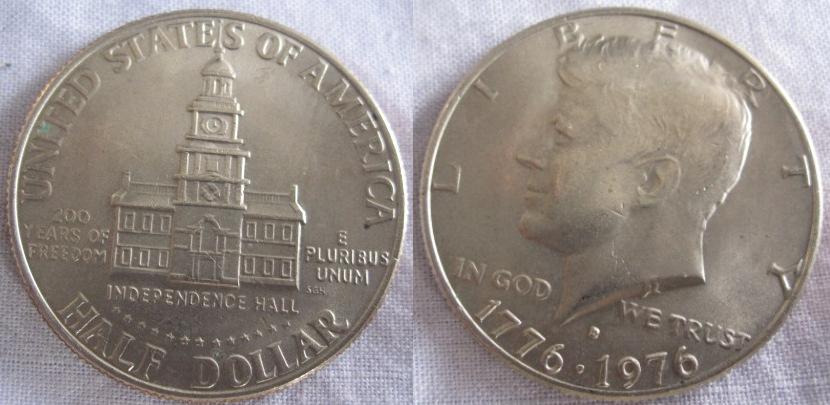
Kennedy bicentennial,1976: independence hall
usa kennedy half dollar 1976 bicentennial independence hall
The obverse shows the Kennedy head and the reverse shows the independence hall. Independence Hall is a U.S. national landmark located in Philadelphia, Pennsylvania, on Chestnut Street between 5th and 6th Streets. Known primarily as the location where both the Declaration of Independence and the United States Constitution were debated and adopted, the building was completed in 1753 as the Pennsylvania State House for the Province of Pennsylvania. It became the principal meeting place of the Second Continental Congress from 1775 to 1783 and was the site of the Constitution Convention in the summer of 1787. The building is part of Independence National Historical Park and is listed as a World Heritage Site.


Kennedy half dollar, 1971
USA half dollar kennedy 1971The Kennedy half dollar came into circulation roughly three months after the assassination of the then president John Fitzgerald Kennedy, often referred to as JFK. It replaced the Franklin half dollar a good 9 years before the coin was eligible for a change after a bill was hurriedly passed in the congress following the assassination. The first Kennedy half dollar came out in 1964 which was 90% silver. Because of rising silver prices, in 1965 it was changed to silver clad coin having about 40% silver content. In 1971, the composition was changed to the current standard of copper-nickel clad copper and the silver was removed completely. The coin features the Kennedy head on the obverse and an eagle on the reverse, which is also the seal of the president of the united states.

Prelude:
John F. Kennedy (1917-1963) was the 35th President of the United States, serving from 1961 until his assassination in 1963.

After Kennedy's military service as commander of the Motor Torpedo Boat PT-109 during World War II in the South Pacific, his aspirations turned political. With the encouragement and grooming of his father, Joseph P. Kennedy, Sr., Kennedy represented Massachusetts's 11th congressional district in the U.S. House of Representatives from 1947 to 1953 as a Democrat, and served in the U.S. Senate from 1953 until 1960. Kennedy defeated then Vice President and Republican candidate Richard Nixon in the 1960 U.S. presidential election, one of the closest in American history. He was the second-youngest President (after Theodore Roosevelt), the first President born in the 20th century, and the youngest elected to the office, at the age of 43. Kennedy is the first and only Catholic and the first Irish American president, and is the only president to have won a Pulitzer Prize.Events during his administration include the Bay of Pigs Invasion, the Cuban Missile Crisis, the building of the Berlin Wall, the Space Race, the African American Civil Rights Movement and early stages of the Vietnam War.

Kennedy was assassinated on November 22, 1963, in Dallas, Texas. Lee Harvey Oswald was charged with the crime but was shot and killed two days later by Jack Ruby before he could be put on trial. The FBI, the Warren Commission, and the House Select Committee on Assassinations concluded that Oswald was the assassin, with the HSCA allowing for the probability of conspiracy based on disputed acoustic evidence. The event proved to be an important moment in U.S. history because of its impact on the nation and the ensuing political repercussions. Today, Kennedy continues to rank highly in public opinion ratings of former U.S. presidents.

Wednesday, April 7, 2010

Coin handling and storage

HOLA! On popular demand I am posting this article on coin storage from which collectors can benefit. It is intended for beginners but I hope that seasoned collectors may also find it useful.

coin storage is always a big headache for all collectors. If you only collect casually and you have only a few coins, then it is easy to put them into some bowl or box or something. But as your collection increases, the need for proper storage becomes an issue. On a lighter note, too many coins can cause property disputes as they take to much space. Anyhow, if you have many coins and put them together in a box for a period of time, it is quite easy for the coins to get worn out when they come into contact with each other, and the value of the coin is lost. Casual collectors may not know this fact that coin values depend on the condition, apart from the rarity. So how to store them?


Self adhesive resealable pouches
clear resealable self adhesive pouchesThese resealable pouches with self adhesive tape are the best low cost alternative for storage of coins. Albums or holders and sheets are costly and space consuming also. Compared to those, these are best for storage of coins, especially if the coin is having low value but we want to presereve its condition. Lets say we have some 1 rupee coins from circulation in UNC condition, then we would like to preserve their condition but wouldn't want to use holders which are more costly than the coin itself. In that sort of situation pouches like these are the best, and if the coin is small enough, we can store two similar coins in one pouch. The coin can be easily viewed through the pouch as the material is clear. It is non-reactive also so anything from silver to copper may be stored, it takes the least space (every collector has to face this problem as his collection grows), and it has a big advantage over the pouches with lock(shown at bottom) as luster is also preserved in these as opposed to the other pouches shown.


Ideally coins should be stored in proper coin holders, and the coins in the holders should be put into coin sheets or albums. The sheets can be put into sheet cover.

Coin Holder
coin holderThe above figure shows a coin holder. A coin can be placed inside a holder , then folded and stapled. This is a good way to store and preserve coins individually. Care has to be taken to hammer the staples flat or they can rub and tear into some other holder.

Coin sheets and cover
coin sheet holder cover The above figure shows a number of coin sheets with holders put inside the slots for holders. The sheets are bound together by a cover. The holders can also be put in an album. Storing your coins this way makes them look good to anyone you want to showoff your collection.

Resealable plastic pouches
resealable plastic pouches different size2 pound coin in pouch
2 pound coin in resealable plastic pouch1 pound welsh leek coin in pouch
1 pound welsh leek coin in resealable plastic pouchWhen you have a small collection(less than 100 coins) then you can easily store in an album or sheets. But if your collection is large, then there is an issue of the cost involved in buying all these holders, albums and all. The more the coins, the more the cost. So I have an economical solution also: You can store in plastic pouches as shown above. These plastic pouches come in different sizes, are cheap and are easily available at your neighborhood store. The smallest size is the best fit for coins. They cost me about 10 rupees (or 0.2$) for a packet of 100 pouches, and that makes possible to store one coin in each pouch, no matter how low the value of the coin may be. (Though I can easily put 8-10 coins in one pouch of the second smallest size if I want to). Then I can group together the pouches by country or according to some other classification, and keep them in spare boxes that I may have in my home. But Please DO NOT keep silver coins in these pouches as the silver reacts with sulphur in the plastic and blackens, which decreases the desirability and mars the beauty of the coin. The coin holder shown above are better suited for keeping the silver coins as the film in the holders is some non-sulphur material, so silver coins kept in it do not blacken.


DONTS:
  • Never keep your coins in one box as they rub against each other and condition goes down.
  • Never bury them underground as they become dirty and also react with the water in soil.
  • Dont store silver coins in the pouches with lock shown above.
  • Never allow air access to UNC or otherwise valuable copper coins as copper is most reactive. It should be readily kept inside holder or self adhesive pouch.
  • Dont use gel to store coppers as they blacken.

Tuesday, April 6, 2010

Kolkata mint restrike sets

The following is an advertisement by the Kolkata mint in the Hindustan Times dated 28th March, 2010. It says that the booking for SBI, Bhagat Singh, Louis Braille, telecommunications, railways and 150 years of post will be issued from 1st April to 31st May, 2010. If you want to book the sets then you can go to the Kolkata mint site and book from there.

kolkata mint restrike sets ad
My opinion:

1) If say Indian post completes its 150 years in 2004, how can the coin be struck and released in 2010, a good 6 years after the celebration? Ditto for the SBI, telecommunication and post sets. If my birthday comes in December, how can i celebrate in June?

2) Coin collection has an investment side to it as coin values increase over time, some more than other. The value of commemorative sets can possibly double in a period of 2 years, no sweat. So I try to buy my sets at the earliest possible date so that I can get at cheapest cost. Today I am getting a coin for 1000, tomorrow I may not get for 2000. And I also value my collection because after all, it is my hard earned money. The value of coins appreciates and I want the value of my collection to increase over time, not decrease. Now last month only I bought a telecommunication proof set for 3600(It was a good deal as the market value was 4000 then). Now all of a sudden the mint decides to release more sets with the proof being valued at 2500 rupees. That means that I am at a loss. Whose fault is it then in that case? Moreover, this puts a doubt in my mind regarding when to buy. Lets say today I buy a railways set for 11000 thinking that it is rare and value will shoot up further; and the mint people here release a large amount making it not so rare, and the value goes down and my money goes down the drain. Where does that put me as an investor? Do I stop buying coins as it may well be a waste of my money? In that case, what is the difference between investing in coins and the share market?

3) I would like to point out that Subhash Chandra Bose birth centenary was in 1997, and if the coin came out in 1996, then it was called an error or a mistake which should not have happened. We always have something called 'date' on the coin which tells us when this coin was minted. Is it correct to have a coin which is minted in 2010 but showing a date of 2004(this time it is very blatant). Again I am not talking of any rules, but this is definitely something to be thought and pondered over. And from what I hear, the US government has a rule which bans re striking of coins; and don't think there is such a rule here, but I have heard that some collectors are going to file a PIL(public interest litigation) in the Kolkata High court against the further production of such restrikes.

Saturday, April 3, 2010

USA half dollar (silver)

The US half dollar has a diameter of 30mm, that is the size of the Nehru 5 rupee coin or British India silver rupee coins. The coins shown below on this page are all silver coins and the these would be worth about 300-350 rupees each on metal value alone as per their size and weight.

Franklin Half dollar, 1958

usa franklin half dollar 1958The "Franklin Half" is a coin of the United States, minted from 1948 to 1963. The coin pictured Benjamin Franklin on the obverse and the Liberty Bell on the reverse. A small eagle to the right of the bell was necessitated by law; ironically, Franklin himself had opposed the selection of the eagle as the US national symbol, preferring the turkey as a "more noble bird". A bill rushed through Congress after the assassination of John F. Kennedy caused the Franklin half to be replaced by the current Kennedy half dollar in February 1964, nine years before the design would otherwise have been eligible for a change.

This half dollar coin was minted for 9 years, and probably circulated for a little over 10 years as in 1965, the metal for minting the coin was changed from silver to nickel because of the rising silver prices. So people would have kept the silver half dollar with them instead of spending it, and this may be a reason that a large part of the surviving Franklin half dollars and 1964 Kennedy silver half dollars are in good condition. The coin shown above is in BU condition.


Walking liberty half dollar, 1945
usa walking liberty half dollar 1945
The Barber half dollar, though very widely used in circulation, had quite an unpopular design. So a redesign program was started by the then president Theodore Roosevelt for new coinage, as a result of which new coins like the mercury dime or the walking liberty half dollar shown above came into circulation. Many people, including myself, consider the obverse of this coin to be the most beautiful and most well designed silver coin to be circulated in the US.


Barber Half dollar, 1905
us-half-dollar-barber-1905
In 1897, the then US mint director James Kimball submitted his report that the time was due for a redesign of the circulation coins. Some 10 eminent designers were asked to give their designs, but they asked for a preposterous amount for the work. So, the next step was a contest open for the general public for the design. As it is, none of the submitted designs proved to be satisfactory and were rejected. Enter Charles E. Barber, who was given the task of making designs for the new coins. Thus started the series of Barber quarters and dimes, and also the Barber half dollar shown above.

I know what you are thinking now. Why have I put up such a worn out coin here on my site? The fact is, the Barber half and quarter dollars are a conditional rarity, which means that it is very hard to find in higher grade or condition. A Barber half in XF condition would definitely be very rare in XF condition and even in VF condition, it is still quite a valuable coin. I rate the coin shown above as being in VG condition, and i paid 10$ for this one(that is 20 times the face value). The reason for the poor condition is that the Barber series coins were very heavily used in circulation so are highly worn out. This is especially true for the Barber half dollar. From a lot of Barber half dollars, about 85% are expected to be below F condition, and as many as 40% to be below G condition. Thats how worn out these coins are.

The obverse shows the Liberty head with a cap and wreath. This was inspired from ancient Greek and Roman styles. The word 'LIBERTY' appeared on the headband in incuse . The reverse shows an eagle carrying a banner which reads 'E. PLURIBUS UNUM' meaning from many, one. The 13 stars above the eagle represent the original 13 American colonies. In a coin with this much wear and tear, that is not visible.

P.S. If you are a newbie and have trouble with the terminologies on the condition, you can have a look at my article on Coin Grading