Search my blog

Custom Search

For sale

1. iowa/arkansas/ texas/wisconsin state quarter
2.1877 1/2 anna XF-
3.50 years independence unc set
4.Gandhi 10rs
5. unity in diversity(cross) 5 rupees
6.Edward 1/12 anna 1905 UNC
7.1970 1 rupee
8.George V 2 anna AU
9.2004 2rs


If condition is not mentioned then take it to be perfect.

Contact me: koolraj003@gmail.com

"An unidentified coin is a piece of metal. But an identified coin is a piece of history."

"Great collections are built not on money but on passion"

"I can only show you the path. It is you who has to walk on it."

"Collections are not measured in quantity or items you have but in quality and by items missing in collection"

Monday, April 27, 2009

One rupee coins: Republic India-V

1 rupee saint Thiruvalluvar World Tamil conference
1 rupee saint thiruvalluvar tamil conference
St. Thiruvalluvar, the author of THIRUKKURAL was born about 30 years before Jesus Christ in Mylapore, the village of peacocks (Myl in Tamil means peacock), the present day Chennai, at a time when the Tamil Land was rich in culture, vivid in its life and adventurous in its commerce. Valluvars were the priests of outcaste people at that time. Tamilians take cognizance of the birth of Thiruvalluvar as a basis of Tamil calendar according to which we are now in the year 2032 of Thiruvalluvar Aandu (Year). Thirukkural is regarded as a renowned work, eulogized as a directory of code of conduct and ethics to humanity. The revered poet not only deals with the general administration, but also codified clear-cut directions to the mankind on how they should behave and act in a social, political, religious and family circles.

Thiruvalluvar used to keep by his side, when he sat for meals, a needle and a small cup filled with water. Once, his host asked him as to why he insisted on having these two placed by the side of the plate. He said, "Food should not be wasted, even a grain is precious. Sometimes, stray grains of cooked rice or stray pieces of cooked vegetables fall off the plate or away from it. While I eat, I lift them off the floor, with the help of this needle and stir them in the water to clean them and eat them." What a great lesson this is for those who waste more, than they consume in today’s consumerist society!

As Emmons White has said, Thiruvalluvar was a kindly, liberal-minded man and his poetry is a kind of synthesis of the best moral teachings of his age. In the words of Dr. John Lazarus who has made an English translation of the Kural, “It is refreshing to think of a nation which produced so great a man and so unique a work. The morality he preached could not have grown except on an essentially moral soil.” This classical work in Tamil has been widely translated in over 60 languages of the world. Nearly 300 years ago, the Italian Jesuit missionary, Constantius Beschi (known as Veeramamunnivar in Tamil) who came to Tamil Nadu in 1710, translated the Thirukkural into Latin. Rev. G U Pope who hailed Thiruvalluvar as “the Bard of Universal Man” translated the Kural and printed the it first in English. Many European missionaries have made translations into English between 1820 and 1886. Freedom fighters and statesmen, C Rajagopalachari and VVS Iyer have also translated the Kural into English. Barring perhaps the Bible and the Koran, the Kural is the most translated work.

Erudite Tamil Poets as well as the kings of the three Tamil Kingdoms – Chera, Chola and Pandya – acknowledged the literary greatness of Thirukkural. It is said that at the time of its first presentation to the king’s court, the Pandyan king wanted its greatness to be known to his whole kingdom. He put it to test by placing the manuscript along with those of other contemporary works in a golden lotus plank and allowed it to float in the tank at the Madurai Meenakshi temple. The sanctified plank that would recognize only the masterpieces is said to have rejected all other works and retained only the Thirukkural.

People in Tamil Nadu worship Thiruvalluvar as a guru. They have erected a beautiful shrine to him and to his wife in the midst of a garden in Mylapore. It lies not far from the waves of the sea that are often referred to in his verses. Every year in the month of April, people celebrate a grand festival at the shrine. Another important memorial to the immortal saint is Valluvar Kottam in Chennai, which is shaped like a temple chariot. A life size statue of Thiruvalluvar has been installed in the tall chariot. The 133 chapters of his work have been depicted in bas-relief in the front hall corridors of the chariot. The auditorium at Valluvarkottam is said to be the largest in Asia with accommodation capacity for 4000 people. Recently, Tamil Nadu government has erected a magnificent 133-foot height statue of the saint denoting the 133 chapters in Thirukkural for tourists in the midst of sea in Kaniyakumari (Cape Comerin) at the confluence of the three seas.

While being sworn in as the president of India, Dr. Abdul Kalam said that a country needs to have the characteristics as enshrined in Thirukkural and quoted from the Kural: “ Pini inmai Selvam Vilaivinbam Emam, aniyenba Nattirku vainthu”. That is “The important elements that constitute a nation are: being disease free; wealth; high productivity; harmonious living and strong defence.” It makes deep sense in this fast-moving world. If only there is more forbearance and patience, mutual respect and understanding, the world would become a better place for all of us to live.


One rupee, 2004
Weight: 4.85gm
Metal: stainless steel
Diameter: 25mm
Obverse: lion pedestal, "satyamev jayate"
Reverse: denomination, date and grain ears
Edge: plain


One rupee, 1988
one rupee 1988
Weight: 6gm
Metal: Copper-nickel
Diameter: 26mm
Obverse: lion pedestal, seven sided surrounding
Reverse: denomination,date and grain ears


One rupee, small farmers:1987
1 rupee small farmers
This coin is also one of the number of commemorative coins that were minted around or just succeeding the green revolution in India. Through this coin, the government acknowledges the important contribution of the small farmers to India's foodgrain produce. The green revolution was what caused India to move from being a food deficit nation to a food surplus. A large share of the country's farms are not large scale, but small scale and manual labour done is more than the overall work done through large machines. That is, the work done is mostly labour intensive. Simply put, the contribution of the small farmers to the produce cannot be overlooked.

Thursday, April 23, 2009

One rupee coins: Republic India - IV

1 rupee, Rajiv Gandhi
1 rupee rajiv gandhi
Rajiv Gandhi (20 August 1944 – 21 May 1991), the elder son of Indira and Feroze Gandhi, was the 9th Prime Minister of India from his mother's death on 31 October 1984 until his resignation on 2 December 1989 following a general election defeat. He became the youngest Prime Minister of India when he took office (at the age of 40).

Rajiv Gandhi was a professional pilot for Indian Airlines before entering politics. While at Cambridge, he met Italian-born Sonia Maino whom he later married, who is now supposedly the hand pulling the strings behind the current prime minister Manmohan Singh. Rajiv Gandhi remained aloof from politics despite his mother being the Indian Prime Minister , and it was only following the death of his younger brother Sanjay Gandhi in 1980 that Rajiv entered politics. After the assassination of his mother in 1984 after Operation Blue Star, Indian National Congress party leaders nominated him to be Prime Minister.

Rajiv Gandhi led the Congress to a major election victory in 1984 soon after and lost soon after due to racism, amassing the largest majority ever in Indian Parliament. The Congress party won 411 seats out of 542. He began dismantling the License Raj - government quotas, tariffs and permit regulations on economic activity - modernized the telecommunications industry, the education system, expanded science and technology initiatives and improved relations with the United States.

In 1988, Rajiv reversed the coup in Maldives antagonising the militant Tamil outfits such as PLOTE. He also was responsible for sending Indian troops (Indian Peace Keeping Force or IPKF) for peace efforts in Sri Lanka, which soon ended in open conflict with the Liberation Tigers of Tamil Eelam (LTTE) group. In mid-1987, the Bofors scandal broke his honest, corruption-free image and resulted in a major defeat for his party in the 1989 elections.
.

Apart from the bofors scandal, Rajiv's major failure was in checking inflation as during the early 1980's, the rupee fell from 12 to 17 per dollar.

He also efforts to enable significant developments in India. He introduced measures significantly reducing the License Raj, allowing businesses and individuals to purchase capital, consumer goods and import without bureaucratic restrictions. In 1986, he announced a national education policy to modernize and expand higher education programs across India. He founded the Jawahar Navodaya Vidyalaya System in 1986. His efforts created MTNL in 1986, and his public call offices, better known as PCOs, helped spread telephones in rural areas.

Rajiv Gandhi remained Congress President until the elections in 1991. While campaigning, he was assassinated by the Liberation Tigers of Tamil Eelam (LTTE) group.His widow Sonia Gandhi became the leader of the Congress party in 1998, and led the party to victory in the 2004 elections. His son Rahul Gandhi is a Member of Parliament and the General Secretary of All India Congress Committee.

Rajiv Gandhi was posthumously awarded the Highest National Award of India, Bharat Ratna, joining a list of 40 luminaries, including Indira Gandhi.


1 Rupee, 2004
1 rupee 2004 cross
The coin posted above is a very very very rare coin and from what I have heard, only 1 packet is known to have been opened, that is only 100 coins are supposed to be in collector's circle. Many people have bought this coin for 6-8 thousand rupees, or about 8,000 times its face value. There is no telling what the value of such an item could possibly be in the times to come.

1 rupee, 2005
1 rupee 2005 cross
1 rupee, 2006
1 rupee 2006 cross

Weight: 4.95 grams
Diameter: 24.8mm.
Obverse: Cross dividing four dots.

In this one rupee coin, the obverse shows a "plus" symbol with four dots on each side instead of the usual lion capital or the map of India. This symbol is believed to be a Christian cross, introduced on the coins through the RBI by the tsarina, the ElizabethI of India. A lot of hue and cry was raised as the symbol was believed to be a Christian cross , and Mr. Narendra Modi has gone to lengths bringing this symbol on the rupee to the notice of the prople, causing the RBI to withhold the mintage of this design of the Indian rupee with the "cross". This rupee with the cross was minted only for the year 2005 and after that this rupee was withdrawn.

What is the difference between the Christian Cross seen on 2 Rupee Coins minted in 2006 and 1 Rupee Coins minted in 2005? The Christian Cross put into the 2 Rupee Coins issued in 2006 was supposedly a calculated and mischievous pseudo-secular experiment deriving its sanction from Suppressio Veri Suggestio Falsi (suppression of truth and suggestion of falsehood) for which the UPA Government in general and the Congress Party in particular own global monopolistic patents. Perhaps there was an element or grain of vagueness about it. Such vagueness or ambiguity or ambivalence as existed about the Christian Cross on the 2 Rupee Coins of 2006, was completely removed in respect of the 1 Rupee Coins of 2005. The Christian Cross inscribed on the 1 Rupee Coins of 2005 makes it loud and clear that it is a routine Christian Cross.

The 1 Rupee Coin minted in 2005 bearing the ‘Christian Crusader’s Cross’ shown above resembles the Gold Coin issued by Louis the Pious (778 AD-840 AD), also known as Louis I, Louis the Fair, and Louis the Debonaire. He was Emperor and King of France from 814 to his death in 840. He issued a coin bearing a Christian Crusader’s Cross which has been copied by the Mint Master who included the same Cross on one side of the new 1 Rupee coin minted in 2005.

When there was a massive public outcry against these Christian Coins, the UPA Government quietly withdrew these coins from circulation.

Officially,the theme of this 1 rupee coin is unity in diversity.

All that being said, I still support the current government since lots of progress has been there in the last 5 years; it doesnt matter to me if the above symbol is a christian cross or not.

See also:
Unity in diversity 10 rupee

Wednesday, April 15, 2009

One rupee coins: Republic India-III

1 Rupee: 89th inter parliamentary union conference
1 rupee 89th inter parliamentary union conferenceEstablished in 1889, the inter parliamentary union is a body which signifies unity between the parliaments or senates of different countries. In 1993, the 89th inter parliamentary union conference was held at New Delhi in the Indian parliament. The main objective of the union is to achieve peace and coordination between the different member countries. Apart from the 89th conference , the 57th conference was also held at Delhi.


One rupee, 2008

We know well of the hue and cry that was raised on the issue of the rupee with a "cross". (see one rupee coins: republic india-IV). As there was a massive outcry against the apparent forced evangelization of India through these coins, the 1 rupee coin with the "cross" was quietly withdrawn and replaced by the coin shown above.

One rupee: Food for the future
one rupee food for future
Weight: 6gm
Metal: copper-nickel
Subject: food for the future

The world's worst recorded food disaster happened in 1943 in British-ruled India. Known as the Bengal Famine, an estimated four million people died of hunger that year alone in eastern India (that included today's Bangladesh). The initial theory put forward to 'explain' that catastrophe was that there as an acute shortfall in food production in the area. However, Indian economist Amartya Sen (recipient of the Nobel Prize for Economics, 1998) has established that while food shortage was a contributor to the problem, a more potent factor was the result of hysteria related to World War II which made food supply a low priority for the British rulers. The hysteria was further exploited by Indian traders who hoarded food in order to sell at higher prices.

During the period from 1967 to 1978, India witnessed a green revolution. Between 1947 and 1967, efforts at achieving food self-sufficiency were not entirely successful. Efforts until 1967 largely concentrated on expanding the farming areas. But starvation deaths were still being reported in the newspapers. In a perfect case of Malthusian economics, population was growing at a much faster rate than food production. This called for drastic action to increase yield. The action came in the form of the Green Revolution.

As a "side effect" of India moving from the status of a food surplus nation from being a food deficit nation with the green revolution, a number of different commemorative coins were minted during that era on themes related to food, work, shelter and all. These two coins shown here are in that series only.


One rupee,1991: parliamentary conference
one rupee 1991 parliamentary conference
Weight: 6gm
Metal: copper-nickel
Subject: commonwealth parilamentary conference

The Commonwealth Parliamentary Association, previously known as the Empire Parliamentary Association, is an organsation, of British origin, which works to support good governance, democracy and human rights. It was founded as the Empire Parliamentary Association in 1911, with its first branches being Australia, Canada, Newfoundland, New Zealand, South Africa and the United Kingdom, the latter branch administering the association as a whole. In 1948 the association changed its name to the current Commonwealth Parliamentary Association, and allowed all branches part in administration of the organisation. The branches are grouped into nine Commonwealth regions - Africa; Asia; Australia; British Islands and Mediterranean; Canada; Caribbean, Americas and Atlantic; India; Pacific, and South-East Asia.

As of 1989, the organisation acknowledges a Patron - the Head of the Commonwealth; Her Majesty Queen Elizabeth II - and a Vice Patron, the head of state or of the government of the branch holding the upcoming conference. The association's supreme authority is the General Assembly, constituted by delegates to the annual Commonwealth Parliamentary Conference. The business and activities are managed by an Executive Committee, which reports to the General Assembly. The association's funds are obtained from membership fees paid by its branches, as well as from two trust funds and various other sources.

The 37th commonwealth parliamentary conference was held at the Indian parliament in New Delhi and commemorative coins were issued for the same.

Tuesday, April 7, 2009

One rupee coins: Republic India-II

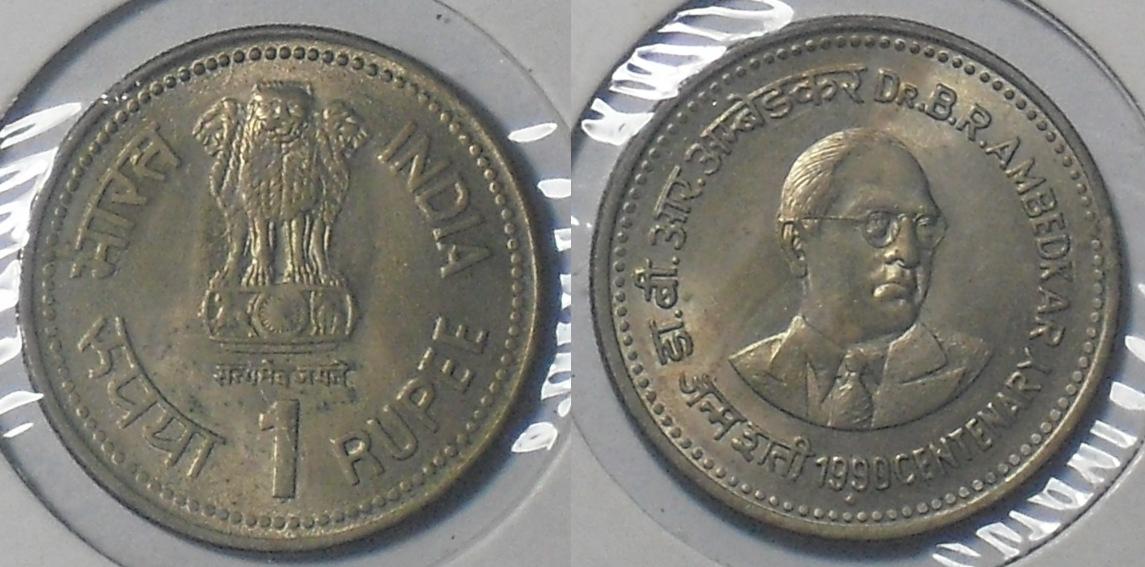
1 rupee: BR Ambedkar centenary, 1990
1 rupee bhimrao ambedkar centenary 1990We can see BhimRao Ramji Ambedkar , also known as Babasaheb Ambedkar on the obverse. Dr. B.R.Ambedkar was the architect of India's constitution. He was born into an untouchable family and spent his life fighting the prejudices and the discrimination base on which the Hindu society was divided into four classes, or the Chaturvarna: the Brahmans, the Kshatriyas, the Vaishyas and the Shudras. Facing numerous social and Italicfinancial obstacles, which were seemingly insurmountable, Ambedkar went overseas and returned a scholar having multiple doctorates with extensive research in the fields of law, economics and political science from Columbia university and the London school of economics.

Ambedkar led an extensive fight against the practice and prejudices of untouchability. He became an active member of the Bombay legislative assembly in 1926 and in 1927 he started some movements against untouchability.He began with public movements and marches to open up and share public drinking water resources, also he began a struggle for the right to enter Hindu temples. He led a satyagraha in Mahad to fight for the right of the untouchable community to draw water from the main water tank of the town.

He is also credited with having sparked the Dalit Buddhist movement. Ambedkar has been honoured with the Bharat Ratna, India's highest civilian award.


One rupee, 1976
Indian one rupee 1976
Weight: 10gm
Metal: Nickel
Obverse: Ashoka lion pedestal
Reverse: denomination and date

one rupee: cellular jail port blair-1997
Indian one rupee cellular jail port blair
This coin was released on the occasion of India's 50th anniversary of independence in 1997 by the then president Mr.K.R.Narayanan, and he also gave a a moving speech at the Jail to honour the former inmates of the cellular jail in Port Blair, Andaman and Nicobar Islands. The jail was established during India's struggle for independence with the view to send the freedom fighters to some deserted islands, so that their links to their families and communities would be severed and they would be forgotten into oblivion. The sentencing to the cellular jail was known as "saza-e-kalapani" and was the most dreaded punishment at that time if you were caught by the British government, probably even more dreaded than capital punishment. When the sepoy mutiny and the first all India war of independence was supressed, most of the freedom fighters were killed by hanging, bound to cannons and blown to bits or killed by guns and swords. Those who survived were sent to the Andaman Islands , where the only human inhabitants were the local tribes or Adivasis, like the Australian Aborigines. The island was a pure jungle.

Now, the history of the cellular jail is as fascinating as it is horrendous, as romantic as it is tragic. Unfortunately when the Japanese captured the Andaman Islands during the second world war, they burned down whatever was there, and all of the records that the British had kept were obliterated. This was a great loss to India's history as even though the British were exploiters, but they were also great record keepers. Even though extensive research has been done by the subsequent governments of India post independence, precious little has been found to establish the chronicles of the cellular jail.

The earliest revolutionaries to be sent to the Andaman islands had to face the worst treatment. In perennial rainy weather and marshy land, with snakes, scorpions etc around them and bound by heavy shackles, chains and fetters, they had to cut trees to clear paths in the jungle. They got flogged every time they slowed down and were not even given a full meal in a day. After the revolt of 1857, prisoners from national revolutionary movements, Alipore conspiracy case, Gadar party revolutionaries, Assembly bomb case, second Lahore conspiracy case, and from the Chittagong revolt of 1930 were also kept. The most famous inmate of the Jail was Veer Vinayak Damodar Savarkar (1883-1966)

The prisoners in the jail got highly inhuman treatment. According to Savarkar Freedom Fighters were made to do hard labour. They had to peel coconuts and take out oil from them. They were forced to go around like bullocks to take out oil from mustard seeds. Outside they were forced to clear the jungles and trees on hillside levelling marshy land. They were flogged on refusal. On top of this they did not even get a full meal every day.The food that was given was not fit for human consumption. There were worms when you opened the bread and wild grass was boiled and served in lieu of vegetables. Rain drinking water was full of insects and worms. The 13' X 6' cells were dark and damp and dingy thickly coated with moss. There were no toilets. There were no lights, no reading material. Prisoners were not allowed to meet with each other. The guards carried out physical torture and flogging. Their behaviour was insulting. Things had become unbearable.

So as a result, the only alternative before the freedom fighters was to resort to a hunger strike against these atrocities. On 12 May 1933 they started a fast undo death. Mahavir Singh, Mohan Kishore Namo Das and Mohit Moitra died during this hunger strike. Their bodies were quietly ferreted away and thrown out to sea. Punjab's jail inspector Barker was called to break the hunger strike. He issued orders to stop the issuing of drinking water. The freedom fighters were resolute. There was a huge outcry throughout India because of this hunger strike. After 46 days the British Raj had to bow and the demands of the freedom fighters had to be accepted. The hunger strike ended on 26 June 1933.

After the death of three colleagues the facilities won from jail authorities proved beneficial for the future. There was light in the cells. The prisoners started getting newspapers, books and periodicals. They were allowed to meet. The facility to read individually or on a collective basis was allowed. The opportunity to play sports and organise cultural events was given. The jail work was reduced to minimal. Above all there was respect for the freedom fighters from the prison officials and a marked improvement in their behaviour. A new environment was created as the freedom fighters met to discuss and read. A thirst for books and knowledge began. There were students, doctors, lawyers, peasants, and workers all together. They discussed politics, economics, history and philosophy.

There were classes in biology and physiology given by the doctors amongst them. Others gave classes in historical and dialectical materialism. Knowledge, experience and books were hungrily shared. A jail library was started. A veritable university of freedom fighters had begun where revolutionaries were learning about Marxist and socialist ideas and how to disseminate these amongst the people whose freedom they were fighting for. A Communist consolidation was formed of 39 prisoners on 26 April 1935. This number later swelled to 200. The freedom fighters started feeling that the atmosphere for a world war was gathering and that before the war starts we should get back to our country to be with our people and take active part in the upheaval that was imminent. A petition was sent to the Viceroy on 9 July 1937 by the freedom fighters that all political prisoners should be repatriated to the mainland and released An ultimatum was given that if these demands were not met a hunger strike would begin.

A second hunger strike began for the repatriation of freedom fighters on 25th July 1937.A country wide movement on the mainland in support of the demands of the Andaman freedom fighters began as other political prisoners in other jails on the mainland also started hunger strikes in support. There was a mass demonstration of working people, intellectuals and students. This upsurge clearly showed that their people on the mainland did not forget them. After four weeks telegrams from Bengal's chief minister, leaders of the nation Jawaharlal Nehru, Subhash Chandra Bose, Sharad Chandra Bose, Rabindra Nath Tagore etc poured in imploring the freedom fighters to end their hunger strike.On 28 August 1937, Gandhiji, poet Rabindra Nath Tagore and the Congress Working Committee sent a telegram…"the whole nation appeals to you to end the hunger strike… and assures you to take up your demands and to see them fulfilled…" After a lot of deliberation and discussion this historic 36-day hunger strike of 200 revolutionary freedom fighters ended. The process of repatriation started in September 1937.

Netaji Subhash Chandra Bose's Azad Hind Fauz first of all gave independence to Port Blair, Andaman. Netaji visited the Andaman Island and hoisted the tricolour flag on 30 December 1943. He had declared that the very first bastion to be relieved of the British yolk was Andamans, the Indian Bastille revolutionary freedom fighters were kept, very much like the Bastille in Paris during the French Revolution. The British reoccupied the Andaman and Nicobar Islands and abolished the Penal Settlement in 1945.

The Japanese destroyed two of the wings of the cellular jail during their brief occupation of the Andamans. Post independence the demolition of the jail was started(dont know or understand the logic behind it) and two more wings were destroyed. The former inmates of the jail intervened and the remaining three wings were spared, and the jail is now a national memorial in 1969, and the Gobind Vallabh Pant hospital was also started.

In 2004, parts of the jail were damamged by the Indian Ocean tsunami.


One rupee, 15 years of I.C.D.S.: 1975-1990
one  rupee 15 years of I.C.O.S. 1975-1990
Weight: 6 gm
Metal: Copper-nickel
Diameter: 26mm
Subject: 15th anniversary of I.C.D.S.
Obverse: lion pedestal, denomination below
Reverse: Seated figure holding child, radiance surrounds.

I.C.D.S. stands for integrated child development services. The children are the most important aspect for Human Resource development as it is in the first 5-6 years of our lives that the foundations for cognitive, social, emotional and physical/motor development and also for life long learning.

The government acknowledged this fact and launched the integrated child development services(ICDS) in 1975 with a view for holistic development of the child.

The objectives of ICDS:

1)Lay the foundation for proper psychological development of the child

2)Improve nutritional & health status of children 0-6 years

3)Reduce incidence of mortality, morbidity, malnutrition and school drop-outs

4)Enhance the capability of the mother and family to look after the health, nutritional and development needs of the child

5)Achieve effective coordination of policy and implementation among various departments to promote child development


The services of ICDS include supplementary nutrition, non-formal pre school education, immunization, health check-up, referral services and nutrition and health education.


The pulse polio immunization campaign is the most well known initiative undertaken by ICDS.

Sunday, April 5, 2009

one rupee coins: Republic India-I

1 rupee Saint Dnyaneshwar
1 rupee saint dnyaneshwar
Sant Dnyaneshwar was a Marathi poet, philosopher, saint and a yogi of Nath tradition. His works Bhavarth Deepika Teeka and Amrutanubhav are considered to be milestones in Marathi literature. Bhavarth deepika teeka is an analysis of the bhagwad Gita and is also called Dnyaneshwari. Dnyaneshwar entered into "sanjeevan samadhi", a yogic path to salvation at 21 in Alandi, Maharashtra.Dnyaneshwar was the second of four children, the first being Nivruttinath, and the other two being Sopandeo and Muktabai of Vitthal Govind Kulkarni and Rukmini. Vitthal had studied the Vedas and was more intereted in "the search of god", but Rukmini's father Shridharpant was impressed of Vitthal and convinced him to marry his daughter.

Vitthal's inclination was still towards sainthood and he somehow convinced his reluctant wife to let him leave the Grihastha ashram (tied to his home and family) and enter Sanyas ashram(to live a life of celibacy and sainthood) . He went to Ramanand Swami and found acceptance after lying about his past and hiding his married life.

Ramanand Swami once came to Alandi and blessed Rukmimi "ashta putra saubhagyavati bhava" (you may have 8 sons). Rukmini broke down and told her story. Ramanda Swami came to the conclusion that Vitthal was her husband and he had deserted his wife and home. So he told Vitthal to leave the sanyas and follow his duties in his home. This caused Vitthal's expulsion from the Brahmin community as he had reverted back to "Grihastha ahsram" after "Sanyas ashram" , which was the last ashram.

Meanwhile, the pious couple had four children. Vitthal tried to get acceptance into the Brahmin community of Paithan but failed, and the couple were told to end their lives. The family went on a pilgrimage and Vitthal and Rukmini jumped into the waters of Prayag at the confluence of Ganga and Yamuna, hoping that their children would get acceptance into the community.

The orphaned children lived on alms for a while, and afterwards tried to get acceptance into the community, and were accepted on the condition of celibacy. Nivruttinath took Dnyaneshwar and the other two siblings under his tutelage, and later on not only Dnyaneshwar , but the other three also became highly revered saints in their capacity.


One rupee: Mahatma Gandhi centenary 1969
1 rupee mahatma gandhi centenary 1969
1 rupee mahatma gandhi 1969
Any description of India's history in the British era can never be complete without the mention of Mohandas Karamchand Gandhi, better known as Mahatma Gandhi. Mahatma Gandhi was born in 1869 in Porbandar in Gujrat, and died in 1948 when he was shot by Nathuram Godse. Mahatma Gandhi was one who preached non-violence in an era of violence, world wars and all and successully led the country to independence through non-violent means like protests etc.

The Gandhis belong to the Bania caste and seem to have been originally grocers. But for three generations, from Mahatama Gandhi's grandfather, they have been Prime Ministers in several Kathiawad States. Uttamchand Gandhi, alias Ota Gandhi, was his grandfather.

Ota Gandhi married a second time, having lost his first wife. He had four sons by his first wife and two by his second wife.. The fifth of these six brothers was Karamchand Gandhi, alias Kaba Gandhi, and the sixth was Tulsidas Gandhi. Both these brothers were Prime Ministers in Porbandar, one after the other. Kaba Gandhi was Mahatma Gandhi's father. He was a member of the Rajasthanik Court. It is now extinct, but in those days it was a very influential body for settling disputes between the chiefs and their fellow clansmen.

Kaba Gandhi married four times in succession, having lost his wife each time by death. He had two daughters by his first and second marriages. His last wife, Putlibai, bore him a daughter and three sons, Mahatma Gandhi being the youngest.

Gandhi remained in South Africa for twenty years, suffering imprisonment many times. In 1896, after being attacked and humiliated by white South Africans, Gandhi began to teach a policy of passive resistance to, and non-cooperation with, the South African authorities. Part of the inspiration for this policy came from the Russian writer Leo Tolstoy, whose influence on Gandhi was profound. Gandhi also acknowledged his debt to the teachings of Christ and to the 19th-century American writer Henry David Thoreau, especially to Thoreau's famous essay "Civil Disobedience." Gandhi considered the terms passive resistance and civil disobedience inadequate for his purposes, however, and coined another term, Satyagraha (from Sanskrit, "truth and firmness"). During the Boer War, Gandhi organized an ambulance corps for the British army and commanded a Red Cross unit. After the war he returned to his campaign for Indian rights. In 1910, he founded Tolstoy Farm, near Durban, a cooperative colony for Indians. In 1914 the government of the Union of South Africa made important concessions to Gandhi's demands, including recognition of Indian marriages and abolition of the poll tax for them. His work in South Africa complete, he returned to India.

Then Gandhi became a leader in a complex struggle, the Indian campaign for home rule. Following World War I, in which he played an active part in recruiting campaigns, Gandhi, again advocating Satyagraha, launched his movement of non-violent resistance to Great Britain. When, in 1919, Parliament passed the Rowlatt Acts, giving the Indian colonial authorities emergency powers to deal with so-called revolutionary activities, Satyagraha spread throughout India, gaining millions of followers. A demonstration against the Rowlatt Acts resulted in a massacre of Indians at Amritsar by British soldiers; in 1920, when the British government failed to make amends, Gandhi proclaimed an organized campaign of non-cooperation. Indians in public office resigned, government agencies such as courts of law were boycotted, and Indian children were withdrawn from government schools. Throughout India, streets were blocked by squatting Indians who refused to rise even when beaten by police. Gandhi was arrested, but the British were soon forced to release him. Gandhi advocate economic independence by boycotting English goods.

Gandhi became the international symbol of a free India. He lived a spiritual and ascetic life of prayer, fasting, and meditation. His union with his wife (Kasturba Gandhi) became, as he himself stated, that of a brother and sister. Refusing earthly possessions, he wore the loincloth and shawl of the lowliest Indian and subsisted on vegetables, fruit juices, and goat's milk. Indians revered him as a saint and began to call him Mahatma (great-souled), a title reserved for the greatest sages. Gandhi's advocacy of nonviolence, known as ahimsa (non-violence), was the expression of a way of life implicit in the Hindu religion. By the Indian practice of nonviolence, Gandhi held, Great Britain too would eventually consider violence useless and would leave India.

When World War II broke out, the Congress party and Gandhi demanded a declaration of war aims and their application to India. As a reaction to the unsatisfactory response from the British, the party decided not to support Britain in the war unless the country were granted complete and immediate independence. The British refused, offering compromises that were rejected. When Japan entered the war, Gandhi still refused to agree to Indian participation. He was interned in 1942 but was released two years later because of failing health.

By 1944 the Indian struggle for independence was in its final stages, the British government having agreed to independence on condition that the two contending nationalist groups, the Muslim League and the Congress party, should resolve their differences. Gandhi stood steadfastly against the partition of India but ultimately had to agree, in the hope that internal peace would be achieved after the Muslim demand for separation had been satisfied. India and Pakistan became separate states when the British granted India its independence in 1947 (see: Tryst with Destiny -- the story of India's independence). During the riots that followed the partition of India, Gandhi pleaded with Hindus and Muslims to live together peacefully. Riots engulfed Calcutta, one of the largest cities in India, and the Mahatma fasted until disturbances ceased. On January 13, 1948, he undertook another successful fast in New Delhi to bring about peace, but on January 30, 12 days after the termination of that fast, as he was on his way to his evening prayer meeting, he was assassinated by a fanatic Hindu, Nathuram Godse.

Gandhi's death was regarded as an international catastrophe. His place in humanity was measured not in terms of the 20th century, but in terms of history. A period of mourning was set aside in the United Nations General Assembly, and condolences to India were expressed by all countries. Religious violence soon waned in India and Pakistan, and the teachings of Gandhi came to inspire nonviolent movements elsewhere, notably in the U.S.A. under the civil rights leader Martin Luther King, Jr. and in South Africa under Nelson Mandela.

Even though the greatness of Mahatma Gandhi as a leader and his impact on India's and even world's history is indisputable and unquestionable, yet there was a faction of revolutionaries in India who believed that if Gandhi had not been in the picture, there would have been a popular uprising in India and the British would have have thrown out of India long before 1947, when India eventually got its independence.

This coin was just one in a series of commemorative coins that were issued in 1969 which happens to be the centenary of Mahatma Gandhi's birth. Coins of denomination 10 paisa, 20 paisa and 50 paisa were also minted, not to mention the First 10 rupee coin of republic india, which was composed of 80% silver.


See also:

Gandhi 20 paise

Gandhi 50 paise

Gandhi 10 rupee coin


1 rupee, International year of family
1 rupee international year of familyIn 1989, the United Nations declared that 1994 would be the international year of the family. The Indian government launched a coin made in stainless steel marking the year of the family. The objective of the UN was to raise awareness regarding family issues in the local, national and international organizations. Many universities in the field of human development also held presentations, symposiums and all in order to spread awareness regarding the different issues of a family. The observance of the year served to highlight the role of the family as the basic social unit in every society and the need to pay adequate attention to the family dimension in development efforts. The significance of the International Year of the Family lies in its reinforcement of the interrelationship between family well-being and sustainable development.

The tenth anniversary of the international year of the family was observed in 2004. India has for long had a policy of "hum do, hamare do" for family planning and to keep a control on the population increase. The phrase means that a family of two (husband and wife) is urged to not have more than two children. And this created an almost stereotyped image of an Indian family for the Indian government, that is the man, his wife, one son and one daughter; and this is most probably the reason we see that sort of a picture of a family on this coin.

Thursday, April 2, 2009

German pfennig

The pfennig was the currency of Germany before the introduction of the Euro. It has been circulated from the 9th century to the introduction of the Euro in 2002, when it ceased to be legal tender. The name Pfennig was derived from the British penny .

In the 9th century, Charlemagne declared that 240 Pfennigs should be minted from a pound of silver. A single coin thus contained 1.5 to 2 grams of silver. Until the 13th century, the pfennig was made from real silver, and thus of high value. From the 12th century on, the King was no longer able to enforce the regalia to mint coins, so many towns and local lords made their own coins, mostly using less valuable metals and less metal per coin, so different Pfennigs had different values. Some renowned coins are the Häller Pfennig, some centuries later called Heller and minted throughout the country, and the Kreuzer (from 'Kreuz', the cross minted on the coins). In the late 17th century the Pfennigs had lost most of their value. The last Pfennig coins containing traces of silver are rarities minted in 1805.

one pfennig,1991
Weight: 2gm
Metal: copper plated steel
Diameter: 16.5mm
Obverse: five oak leaves, date below, 'bundesrepublic deustchland' meaning the federal republic of Germany
Reverse: denomination

5 pfennig, 1986
Weight: 3gm
Diameter: 18.5mm
Metal: brass plated steel
Obverse: five oak leaves, date below, 'bundesrepublic deustchland' meaning the federal republic of Germany
Reverse: denomination

10 pfennig, 1985
Weight: 4gm
Metal: brass plated steel
Diameter: 21.6mm
Obverse: five oak leaves, date below, 'bundesrepublic deustchland' meaning the federal republic of Germany
Reverse: denomination

The significance of the oak leaves: The oak tree is the national tree, a symbol of Germany. Thick woodland is the sort of image that Germany has had for many centuries, with about one-third of the country still being forested. German history is full of lores related to the woods, starting with the German tribal chieftain Hermann, also known as Arminius to the Romans, defeated the invading German legions in the murky forests of Teutoburg. Just as we have a stereotype of a sandy place for the word "Arabia", similarly the Romans had a stereotype of a marshy forest for the word "Germany" for a very long time in history. Even in modern times, there are the romantics and the fairy tales of the Grimm brothers in the 19th century. The tree even finds its way into idioms and epithets like the proud German saying "firm as a German oak".  

But of late, the great German oaks have been threatened by the menace of pollution. The danger to oaks is greater as compared to most other trees as oaks have a long lifespan of about 1000 years; so they tend to accumulate more poison due to pollution over the long years of their lifespan. The number of trees having damaged crowns(upper section including branches and leaves) has gone upto a record 51% due to pollution as well as parasites and other environmental conditions.