Search my blog

Custom Search

Contact me

koolraj003@gmail.com

Sunday, August 30, 2009

Cypriot Pound

Before the introduction of the Euro, the Pound was the currency of Cyprus. Coins were minted starting from 1 cent upto 50 cent. One pound coin was not minted for circulation.


2 cent, 1983
Metal: nickel-brass
Diameter: 19mm
Reverse: stylized goats

10 cent, 1983cyprus 10 centMetal: nickel-brass
Reverse: decorative vase


20 cent, 1994cyprus 20 centMetal: nickel-brass
Diameter: 27mm
Weight: 7.75gm
Reverse: Zamon D. Keteus


50 cents, 2002cyprus 50 centSubject: Abduction of Europa
Reverse: Princess Europa riding bull(Zeus)
Metal: copper-nickel
Diameter: 26mm

Europa (Greek Ευρωπη) was a Levantine woman in Greek mythology, from whom the name of the continent Europe was ultimately taken. There were two competing myths relating how Europa came into the Greek world: in the more familiar one she was seduced by the god Zeus in the form of a bull and carried away to Crete on his back, but according to Herodotus she was kidnapped by Minoans, who likewise were said to have taken her to Crete. The mythical Europa cannot be separated from the mythology of the sacred bull, which had been worshipped in the Levant. The etymology of her name (ευρυ- "wide" or "broad" + οπ- "eye(s)" or "face") suggests that Europa represented a cow, at least at some symbolic level.

The painter Rembrandt Harmenszoon van Rijn created an artwork tilted the Abduction of Europa, which represents the ancient Roman poet Ovids story about the god Jupiter seducing a princess called Europa. This Roman tale was known as The Abduction of Europa and also known as The Seduction of Europa, substituting the god Jupiter for Zeus. Edith Hamilton's Mythology says Zeus, the son of Cronus, overthrew his father to free his five siblings and rule the gods. He is the most powerful of all the gods. Yet he is not invincible. According to Ovid's The Metamorphosis Zeus's father Cronus calls his son aside and asks him 'Son, faithful worker of my commands, go, quickly in your usual way, fly down to where, in an eastern land, they observe your mother's star, among the Pleiads. There drive the group of royal cattle, that you will see some distance off, browsing the mountain grass, towards the sea shore!' Zeus immediately leaves and takes the shape of a bull, a bull that was snow white. His eyes were unthreatening. Europa dared to sit on the bull's back. The god slowly moved from offshore to the shoreline and gradually goes further out to sea. Europa became the first queen of Crete, and she gives birth to a hero, King Minos of Crete.

The Greek 2 Euro also shows Zeus and Europa.

Each coin has the coat of arms on the reverse and the name of the country is written in three different languages- English, Greek and Turkish.

Thursday, August 27, 2009

UAE Dirham


25 Fils: 2005uae 25 filsWeight: 3.5gm
Metal: copper-nickel
Diameter: 20mm
Reverse: gazelle
Date: 2005(AD)-1425(AH)

50 Fils: 1995
Date: 1995(AD)-1415(AH)
Metal: copper-nickel
Diameter: 21mm
Reverse: oil derricks above date

1 Dirham: 2007uae 1 dirham
Weight:11.3gm
Metal: copper-nickel
Reverse: jug above date
Date:2007-1428
1428 is in Muslim date(AH) and it converts to 2007 AD


Countries in the Arabic peninsula generally use Muslim era(AH) for their dating, which commenced on 622 AD when the prophet Mohammed fled from Mecca to Medina. To convert the AH to AD, we subtract 3% of the AH date and then add 622. The muslim calendar has 354 days as it is a lunar calendar and thus it is 2.98% shorter than our year.

Tuesday, August 25, 2009

Foreign mint marks on Indian coins-III


5 rupee: Moscow mint5 rupee moscow mintMoscow mint mark

2 rupee: Tower mint (UK)
2 rupee tower mintTower mint mark
tower mint mark

2 rupee: Pretoria mint(South Africa)2 rupee pretoria mintPretoria mint mark
pretoria mint mark

Saturday, August 22, 2009

Foreign mint marks on Indian coins - II


One Rupee: Birmingham mintone rupee birmingham mintBirmingham mint mark(H below date)
birmingham mint mark

2 Rupee: Moscow mint2 rupee moscow mintMoscow mint mark(MMD in oval)
moscow mint mark

1 Rupee: London mint1 rupee london mintLondon mint mark
london mint mark

Saturday, August 15, 2009

Foriegn mint marks on Indian coins-I


2 rupee: Seoul mint
2 rupee seoul  mint
Seoul mint mark
seoul mint mark


One rupee: Mexico mint
one rupee mexico mint
Mexico mint mark
mexico-mint-mark


One rupee: Slovakia mint
one rupee slovakia mint
Slovakia mint mark
slovakia mint mark


Friday, August 14, 2009

One rupee coins: Republic India-IX

One rupee: Maharana Pratap
1 rupee maharana pratap
Maharana Pratap Singh was a ruler of Mewar and belonged to the Sisodiya clan of Suryavanshi Rajputs. Maharana Pratap Singh is believed to be the epitome of fiery Rajput pride and self-respect; he has exemplified the qualities to which Rajputs aspire for centuries. Maharana Pratap Singh was born as the eldest child among 25 brothers and 20 sisters at Kumbhalgarh on May 9, 1540 to Maharana Udai Singh II and Maharani Javanta Bai Songara (Chauhan). The birthplace of Maharana Pratap Singh is known as Juni Kacheri.

Maharana Pratap Singh, Ruler of MewarIn 1568, during the reign of Udai Singh II, the Mughal emperor Akbar conquered Chittor. The third Jauhar of Chittor became apparent, with the ladies of the fort finding safety from personal dishonour and plunged themselves into fire, while rest of the men folk sallied forth to certain death in the battlefield. Before this condition, Udai Singh and his family had moved to the safety of the nearby hills. He later moved base to another location in the foothills of the Aravalli Range. This new foundation gradually became the city of Udaipur and was accordingly named after him. Udai Singh wished Jagmal, his favorite son could succeed him but his senior nobles wanted Pratap, the eldest son, to be their king. During the coronation ceremony Jagmal was actually moved out of the palace and Pratap was deliberately made the king. Pratap did not want to go against the desire of his father but Rajput nobles convinced him strongly that Jagmal was not capable to rule in the crucial times of the day. It was the beginning of a career of struggle and hardship for Maharana Pratap Singh.

Maharana Pratap Singh never believed Akbar as the ruler of India, and kept on fighting with Akbar all his life. Akbar first tried several diplomatic ways to win over Maharana Pratap but nothing really worked. Maharana Pratap Singh maintained that he had no intention to fight with Akbar, however he could not bow down to Akbar and accept him as the ruler. There was some possibility that Maharana Pratap Singh could have become friends with Akbar, but in the invasion for Chittor Akbar had killed around 30,000 civilians, unarmed residents of Chittor only because they refused to convert to Islam. This left an ever-lasting impression on Maharana Pratap Singh`s mind and he adamant not to bow to such an injustice and cruelty.

See also: Maharana Pratap proof set


One rupee : 150 years of Indian post
one rupee 150 years of post
The Indian Postal Service, with 155,333 post offices, is the most widely distributed post office system in the world (China is next, with 57,000). The large numbers are a result of a long tradition of many disparate postal systems which were unified in the Indian Union post-Independence. Owing to this far-flung reach and its presence in remote areas, the Indian postal service is also involved in other services such as small savings banking and financial services.

History

Ibn Battuta describes the Indian postal system in the 14th century as follows: In India the postal system is of two kinds. The horsepost, called uluq, is run by royal horses stationed at a distance of every four miles. The foot-post has three stations per mile; it is called dawa, that is one-third of a mile ... Now, at every third of a mile there is a wellpopulated village, outside which are three pavilions in which sit men with girded loins ready to start. Each of them carries a rod, two cubits in length, with copper bells at the top. When the courier starts from the city he holds the letter in one hand and the rod with its bells on the other; and he runs as fast as he can. When the men in the pavilion hear the ringing of the bell they get ready. As soon as the courier reaches them, one of them takes the letter from his hand and runs at top speed shaking the rod all the while until he reaches the next dawa. And the same process continues till the letter reaches its destination. This foot-post is quicker than the horse-post; and often it is used to transport the fruits of Khurasan which are much desired in India."

The British East India Company established post offices in Mumbai, Chennai and Kolkata from 1764-1766, each serving the Bombay, Madras and Calcutta presidencies. During Warren Hastings' governorship, postal service was made available to the general public. A letter would cost 2 annas (one-eighth of a Rupee) for distances up to 100 miles (160 km). Payments would be done through copper tokens; a letter was hand stamped "post paid" if paid for, otherwise it was stamped "post unpaid" or "bearing".

In 1839, North West Province Circle was formed and since then, new Postal Circles were formed as needed. In December 1860 Punjab Circle, in 1861 Burma Circle, in 1866 Central Province Circle and in 1869 Sind Circle were formed. By 1880 circles had been formed in Oudh (1870), Rajputana (1871), Assam (1873), Bihar (1877), Eastern Bengal (1878) and Central India (1879).

Afterwards, the creation of new circles was accompanied by the merging of some circles. By 1914, there were only 7 Postal Circles — Bengal & Assam, Bihar & Orissa, Bombay (including Sind), Burma, Central, Madras, Punjab & NWF and U.P.

The different postal services include speed post, ePayment, logistics payment, e-Post, business post, media post, direct post, postal life insurance, instant money order, instant money transfer, non-postal services and adress proof cards

Thursday, August 13, 2009

One rupee coins: Republic India-VIII

1 rupee, care for the girl child
1 rupee care for girl child1990 was designated as the SAARC(South Asian Association for regional cooperation) year of the girl child. SAARC comprises of Afghanistan, Bangladesh, Bhutan, India, Maldives, Nepal, Pakistan and Sri Lanka. The primary aim of SAARC is to promote peace, stability, amity and progress in the given countries.

I got the shown one rupee as change from the post office.


1 rupee, food and nutrition
1 rupee food and nutrition
Weight: 6gm
Metal: Copper-nickel
Subject: food and nutrition

The government of India adopted the National Nutrition policy under the aegis of department of women's and child development in 1993.

Food and nutrition board is primarily engaged in Nutrition Education and Training Activities, Mass Awareness Campaigns, Promotion of Infant and Young Child Nutrition and Follow Up Action on instruments of National Nutrition Policy.

Five-day Training of Trainers (TOT) courses for orienting medical officers, senior supervisors, LHVs etc on various aspects of nutrition are organized. These master trainers in turn organise two-day Orientation Training Courses for the grassroot level functionaries particularly of ICDS and health besides volunteers from the community.

Advertisement campaign for the purpose of mass awareness was generated during 2006 –

1) 2 half page (1 colored ad on 1.8.2006 and 1 Black & white on 7.8.2006) advertisements during the World Breastfeeding Week.
2) 2 half page (1 colored ad on 1.9.2006 and 1 black & white on 7.9.2006) advertisements during National Nutrition Week.
3) One half page color advertisement on 2nd October on the eve of Integrated Child Development Nutrition (ICDS).
4) One half page colored advertisement on World Food Day on the theme ‘Invest in Agriculture for Food Security’ highlighting the importance of diversified diet for better nutrition, health and development.
5) Half page black and white advertisement on Global Iodine Deficiency Disorders Prevention Day highlighting the importance of consumption of iodised salt in our daily diet.

Special awareness generation programmes like Orientation Training Course, community meetings, camps, essay competitions, healthy baby shows etc, were also held during these events.


One rupee: Veer Duragdass
Early life

Durgadas was a suryavanshi Rathore Rajput, belonging to the Karnot branch of the Rathore clan. He was the son of Askaran Rathore, a Rajput general in the army of Maharaja Jaswant Singh. As his mother did not get along with her husband and co-wives, she lived away from Jodhpur, and Durgadas grew up in a small village.

When Durgadas was young, a camelherd, rearing the herds of the Maharaja, ventured into Durgadas's fields. Durgadas asked the camel herd to take his herd away and not destroy the field. The camelherd paid no heed. Durgadas unsheathed his sword and killed him. Word of this reached Maharaja Jaswant Singh. He summoned Durgadas and asked him why he killed the camelherd. Durgadas told him that the royal herd of camels was giving Jaswant Singh a bad name by destroying the crops of ordinary people. The Maharaja was very impressed with Durgadas's uprightness and gave him an appointment in the army.

Saving Ajit Singh

Maharaja Jaswant Singh, ruler of Marwar, died in 1679 without immediate male heirs. However, two of his wives were pregnant at the time of his death. These circumstances allowed the mughal emperor Aurangzeb to intervene; he appointed a Muslim to rule over Marwar, which upset the Rathod clan a great deal. One of Jaswant Singh's pregnant widows gave birth, in due course, to a male child, who was named Ajit Singh. After the birth of this rightful heir, prominent grandees of Marwar, including Durgadas, went to Delhi along with the infant Ajit Singh and asked Aurangzeb that the infant be confirmed in his late father's estates and titles. Aurangzeb did not absolutely refuse, but suggested, supposedly for the infant's own safety, that Ajit grow up in Delhi in front of him.

The nurturing of the head of the Rathod clan in Aurangzeb's staunchly muslim household was not acceptable to the clan. It is said that crown prince Ajit Singh along with his mother was staying at a place called "Bhuli Bhatiyari" near Jhandewalan of modern Delhi. Durgadas and others of the delegation resolved upon smuggling Ajit Singh out of Delhi. Durgadas and his 300 men, notable among them Thakur Mokam singh Balunda and Mukand Das Khichi made a plan. According to the plan Mokam Singh Balunda's wife Bagheliji put her infant girl, in place of Ajit Singh. As they approached the outskirts of the city, the mughal guards fell in hot pursuit and Durgadas and his companions had to make their escape while fighting hand-to-hand battle with the much larger mughal army. Every so often, some 15-20 Rajputs would fall behind to check the mughal pursuers, in the process getting themselves killed. In this battle Mokam singh Balunda, his son Hari singh Balunda got injured, but they managed to keep distance between the forward party and the Mughals.Among them Mokam singh Balunda's wife Bagheli Rani This continued till the evening; Durgadas was left with just seven men out of the 300 he started with, but he managed to escape with the infant Ajit Singh to safety to Balunda. Mokam Singh's wife Bagheliji kept Maharaja Ajit singh at Balunda for almost one year, Later, he was moved to the safety of Aravali hills near Abu Sirohi, a remote town on the southern fringes of Marwar, and grew up in anonymity.

For 20 years after this event, Marwar remained under the direct rule of a Mughal governor. During this period, Durgadas carried out a relentless struggle against the occupying forces. Trade routes that passed through the region were plundered by the guerillas, who also looted various treasuries in present-day Rajasthan and Gujarat. These disorders adversely impacted the finances of the empire.

Durgadas took advantage of the disturbances following the death of Aurangzeb in 1707, to seize Jodhpur and eventually evict the occupying Mughal force. Ajit Singh was proclaimed Maharaja of Jodhpur. He rebuilt all the temples that had been descecrated by the occupying muslims.

Character

Aurangzeb's son Sultan Muhammad Akbar rebelled against his father. Naturally, Durgadas extended aid to him in the rebellion. This venture came to naught, as Akbar died in exile; he left his children in the custody of Durgadas. Aurangzeb became extremely anxious to get his grandchildren back. He requested Durgadas, who agreed to send them to Aurangzeb. When the children arrived, Aurangzeb asked a Qazi to start teaching them the Quran. On hearing this, his little granddaughter began reciting ayats from the holy book. Aurangzeb was left dumbfounded. On being asked, his granddaughter told him that while she was in Durgadas's custody, a Qazi had been engaged to take care of their religious training.

Such was Durgadas. Till today, people in Rajasthan pray: Mayee ehra poot jan jehara DURGADAS, baandh mundaso rakhiyo bin thambe aakash. (Mother, give birth to a son just like Durgadas,who stopped the flooding dam of Moghuls (the Moghul Army) without any support (i.e. single handedly)).

Last breath

Veer Durgadas after completing his duties successfully and fulfilled the promise which he given to Jaswant Singh Ji, left Jodhpur and live in Sadri, Udaipur, Rampura, Bhanpura for some time and then left to worship Mahakaal at Ujjain. On 22nd November 1718, on the banks of the Sipra at Ujjain, Durgadas passed away at the age of 81 years, his beautiful canopy in red stone is still at the Chakrathirth, Ujjain, which is pilgrimage for all freedom fighters and rajputs. Veer Durgadas left behind a shining example of loyalty, chivalry and courage.

See also: Veer Durgadass proof set

Monday, August 10, 2009

One rupee coins: Republic India-VII

One rupee: international youth year
1 rupee international youth yearSymbol on the obverse : three lines between a dove and an olive branch. Both are signs of peace.So in 1985, the youth were urged to bring peace.

International Youth Year, or IYY, was held in 1985, to focus attention on issues of concern to and relating to youth. The proclamation was signed on January 1, 1985 by United Nations Secretary General Javier Pérez de Cuéllar.

Throughout the year, activities took place all over the world. These activities were coordinated by the Youth Secretariat within the Centre for Social Development and Humanitarian Affairs, at the time based at the UN offices in Vienna, Austria. The Secretariat's director, Mohammad Sharif, was also the Executive Secretary for IYY. The President of IYY was Nicu Ceauşescu , son of the former dictator of Romania Nicolae Ceauşescu.

While not organising any specific events itself, under the year's slogan of "Participation, Development, Peace", the IYY Secretariat helped facilitate numerous events helping to make IYY a success.

The main UN event for IYY was the World Congress on Youth (in Spanish: Congreso Mundial Sobre La Juventud) organised by UNESCO and held in Barcelona, Spain July 8-15, 1985. It issued the "Barcelona Declaration" on youth.


One rupee: rainfed farming
1 rupee rainfed farmingWe all know that the water table is continuously going down due to excessive and unmindful usage. Harvesting rainwater for domestic and farming purposes is a solution to replenishing the depleted water table, and this is the reason the government started advocating rainfed farming in 1988.


One rupee: tourism year
one rupee tourism year
The figure shown on the obverse is a stylized peacock. The peacock is the national bird of India.This coin was minted in 1991 when India was trying to promote itself as a tourist destination.

Sunday, August 9, 2009

One rupee coins: Republic India-VI

1 rupee, 1954
1 rupee 1954Rev: Ashoka lion pedestal
Obv: grain ears flank thick numeral
Weight: 11.66gm
Diameter: 24mm
Metal: nickel


1 rupee, 1962
1 rupee 1962Weight: 10gm
Diameter: 28mm
Metal: nickel
Mint: Calcutta(no mint mark)
Remark: larger lion symbol, smaller numeral.
Large 96 in between small 1 and 2 in the date.


One rupee: 1950
one rupee 1950
The first one rupee coin of republic India was released in 1950. After that the one rupee coin came out in 1954; whererafter the design was changed in 1962, with no mintage in the in between years. Since the one rupee coins of 1950 and 1954 were minted only in the Bombay mint, my collection of this coin type is complete.

Friday, August 7, 2009

Two rupee coins: Republic India-VII

2 rupee: Chhatrapati Shivaji
2 rupee chhatrapati sivaji

At the age of 16, he took a pledge to establish a sovereign Hindu state.He clearly outstands all the rulers and generals of India by the exemplary life he lived and is thus respected by the entire cross section of Indians. Shivaji's military skills could be compared to those of Napolean.

He raised a strong army and navy, constructed and repaired forts, used gureilla warfare tactics,developed a strong intelligence network,gave equal treatment to the people from all religions and castes based on merit, and functioned like a seasoned Statesman and General. He appointed ministers with specific functions such as Internal security,Foreign affairs,Finance,Law and Justice,Religious matters,Defence etc.

He introduced systems in revenue collection and warned the officials against harassment of subjects.He thought ahead of times and was a true visionary.In his private life, his moral virtues were exceptionally high.His thoughts and deeds were inspired by the teachings of his mother Jijabai,teacher Dadaji Konddev,great saints like Dnyaneshwar & Tukaram and the valiancy and ideals of the Lords Rama and Krishna.

The tiny kingdom established by Chhatrapati Shivaji known as "Hindavi Swaraja" (Sovereign Hindu state) grew and spread beyond Attock in Northwest India (now in Pakistan)and beyond Cuttack in East India in course of time, to become the strongest power in India. After the death of Chhatrapati Shivaji & his son Sambhaji, their prime ministers or ‘the Peshwas' became the defacto rulers. The Peshwas and the Maratha Sardars (Chieftans) like Shindes of Gwalior, Gaekwads of Baroda & Holkars of Indore contributed to the growth of the Maratha Confederacy.

The history of India is incomplete without the history of Marathas and Shivaji is the nucleus of Maratha history. Shivaji has been a source of inspiration and pride to the past generations and will continue to inspire generations in future.

2 rupee: Chittaranjan Das
2 rupee deshbandhu chittaranjan das
Chittaranjan Das, whose life is a landmark in the history of India's struggle for freedom, was endearingly called 'Deshbandhu' (Friend of the country). Born on November 5, 1870 in Calcutta, he belonged to an upper middle class Vaidya family of Telirbagh in the then Dacca district. His father, Bhuban Moban Das, was a reputed solicitor of the Calcutta High Court. An ardent member of the Brahmo Samaj, he was also well-known for his intellectual and Journalistic pursuits. Chittaranjan's patriotic ideas were greatly influenced by his father's.

In 1894 Das came back to India and enrolled himself as a Barrister of the Calcutta High Court. But he did not get the backing badly needed to make a good start in the profession.

In 1907 he appeared as the defence lawyer of Brahma (bhadhav) Upedhyaya and Bhupendranath Dutta who were prosecuted for sedition. His abilities as an advocate evoked general admiration, though he did not succeed in baffling the prosecution. The turning point in his career came when he was called upon to appear on behalf of Aurobindo Ghose in the Alipore Bomb Case (1908). It was due to his brilliant handling of the case that Aurobindo was ultimately acquitted. This case brought Das to the forefront professionally and politically.

Chittaranjan was the defence counsel in the Dacca Conspiracy Case (1910-11). He was famed for his handling of both civil and criminal law.He came to the forefront of nationalist politics in 1917.

In 1918, both at the Congress special session in Bombay and at the Annual Session in Delhi, Das opposed the scheme of Montagu-Chelmsford Reforms as wholly inadequate and disappointing. The demand for Provincial Autonomy was successfully propounded in the teeth of vehement opposition from Mrs. Besant and others. In 1919 Chittaranjan went to Punjab as a member of the non-official Jallianwala Bagh Enquiry Committee. At the Amritsar Congress (1919) he made the first advocacy of obstruction while opposing the idea of co-operation with the Government in the implementation of the 1919 Reforms.

Deshbandhu wanted "Swaraj for the masses, not for the classes." He believed in non-violent and constitutional methods for the realisation of national independence. In the economic field, Das stressed the need of constructive work in villages. A champion of national education and vernacular medium, he felt that the masses should be properly educated to participate in the nationalist movement. Chittaranjan also made his mark as a poet and an essayist. His religious and social outlook was liberal. A believer in women's emancipation, he supported the spread of female education and widow re-marriage. An advocate of intercaste marriage, he gave his own daughters in marriage Brahmm and Kayastha families.

Chittaranjan passed away on June 16, 1925 at Darjeeling at the age of 55. Great as a jurist, Chittaranjan was the greatest and most dynamic leader of the then Bengal. Above all, he was an apostle of Indian nationalism.

Wednesday, August 5, 2009

Two rupee coins: Republic India-VI

2 rupee Syama Prasad Mukerjee
2 rupee shyama prasad mukerjeeShyama Prasad Mukherjee is considered the godfather of modern Hindutva and Hindu Nationalism. He inherited a rich tradition of erudite scholarship, fervent nationalism and fearlessness from his illustrious father, Sir Asutosh Mookerjee. Mukherjee founded the Bharatiya Jana Sangh, the first Hindu nationalist political party of its kind, and was also the leader of the Hindu Mahasabha and closely associated with the Rashtriya Swayamsevak Sangh. His death created a void in the public life of the nation as a whole and of West Bengal in particular, which is hard to fill. He was one of the few persons who could have given a lead to the intelligentsia of West Bengal in the difficult situation arising out of partition.

Along with Vinayak Damodar Savarkar, Mookerjee is considered the godfather of Hindu nationalism in India, especially the Hindutva movement. He is widely revered by members and supporters of the Rashtriya Swayamsevak Sangh and the Vishwa Hindu Parishad.

Mookerjee was a major role model to Atal Bihari Vajpayee, who made the BJS the chief Hindu conservative political party in the 1960s and 1970s, and founded its successor, the Bharatiya Janata Party. The BJP has become one of the two largest national political parties, the other being the Indian National Congress Party, and had formed the Government from 1998 to 2004, with Vajpayee serving as the Prime Minister of India.

The Post and Telegraphs Department feels privileged to issue a commemorative stamp in honor of this great son of India. On August 27, 1998, the Ahmedabad Municipal Corporation (governed by the BJP) named a bridge after Mookerjee. In 2001, the main research funding insitute of the Government of India named CSIR instituted a new fellowship named after him. The Shyama Prasad Mukhejee Fellowship is the most prestigious fellowship given in India for doing PhD.


2 rupee: Globalizing Indian agriculture(Agriexpo 95)

2 rupee agri expo


2 rupee: Sant Tukaram
2 rupee sant tukaram
Tukaram was born in 1608, in the small village of Dehu in the West Indian state of Maharashtra to Bolhoba and Kanakai a couple belonging to the lower Sudra class. He had two other brothers. Despite their lower class status the family was well to do and enjoyed good social standing in the village. Tukaram's troubles started with the illness of his father, due to which he had to start supporting his family at the tender age of thirteen. Shortly thereafter, both his parents died. Tukaram's problems only mounted; death of his family members and economic hardship seemed to plague him. Tukaram was married twice, his first wife Rakhumabai died due to starvation during a famine, his second wife Jijabai or Avali as she was called, was much younger than his first had been and had little patience with his devotion and for God and she nagged him continuously. He had three sons. Tukaram was initiated without any intermediaries as the other saints usually were. He dreamt that he was initiated by the Lord Hari himself dressed as a Brahman. Tukaram continuously sang the praises of the Lord, he sang it in the form of abhangs which he wrote. These were in his mother tongue Marathi. The abhangs express his feelings and philosophical outlook. During his 41 years, Tukaram composed over 5,000 abhangs. Many of them speak of events in his life, which make them somewhat autobiographical. Yet, they are focused on God, Pandurang, and not Tukaram. His abhangs became very popular with the masses of common people. It was this very popularity that caused the religious establishment (the high caste Brahmins) to hate and persecute Tukaram. as, he was causing them to lose their power over the people. There are many miracles attributed to Tukaram.

Saturday, August 1, 2009

Two rupee coins: Republic India-V

Subhash Chandra Bose netaji 1996 error date
subhash chnadra bose netaji 1996 error dateThe above coin may look like a normal circulated coin. A look at the date and we see 1996; but Subhash Chandra Bose, also known as Netaji, was born in 1897 and his centenary was completed in 1997. The Calcutta mint released a small quantity of Bose centenary coins in 1996, making the above coin a rare one. The date on the coin is the error. This one is quite pricey even in the shown condition, and the current price is shooting up like anything because it is not available at any place.


2 rupee: Subhas Chandra Bose, 1997

2 rupee subhash chandra boseSubhas Chandra Bose ( born January 23, 1897; presumed to have died August 18, 1945 although this is disputed), popularly known as Netaji (literally "Respected Leader"), was a leader in the Indian independence movement.

Bose was elected president of the Indian National Congress for two consecutive terms but had to resign from the post following ideological conflicts with Mahatma Gandhi and after openly attacking Congress foreign and internal policy. Bose believed that Mahatma Gandhi's tactics of non-violence would never be sufficient to secure India's independence, and advocated violent resistance. He established a separate political party, the All India Forward Bloc and continued to call for the full and immediate independence of India from British rule. He was imprisoned by the British authorities 11 times.

His stance did not change with the outbreak of the Second World War, which he saw as an opportunity to take advantage of British weakness. At the outset of the war, he went away from India and travelled to the Soviet Union, Germany and Japan, seeking an alliance with the aim of attacking the British in India. With Japanese assistance, he re-organised and later led the Indian National Army, formed from Indian prisoners-of-war and plantation workers from British Malaya, Singapore, and other parts of Southeast Asia, against British forces. With Japanese monetary, political, diplomatic and military assistance, he formed the Azad Hind Government in exile and regrouped and led the Indian National Army in battle against the allies at Imphal and in Burma.

His political views and the alliances he made with Nazi and other militarist regimes at war with Britain have been the cause of arguments among historians and politicians, with some accusing him of fascist sympathies, while others in India have been more sympathetic towards the inculcation of realpolitik as a manifesto that guided his social and political choices.

Bose advocated complete freedom for India at the earliest, whereas the Congress Committee wanted it in phases, through a Dominion status. Other younger leaders including Jawaharlal Nehru supported Bose and finally at the historic Lahore Congress convention, the Congress had to adopt Purna Swaraj (complete freedom) as its motto. Bhagat Singh's martyrdom and the inability of the Congress leaders to save his life infuriated Bose and he started a movement opposing the Gandhi-Irwin Pact. He was imprisoned and expelled from India. But defying the ban, he came back to India and was imprisoned again.

He is presumed to have died on 18 August 1945 in a plane crash over Taiwan. However, contradictory evidence exists regarding his death in the accident.


2 rupee: Louis Braille
2 rupee louis braille

The lettering on the reverse below figure in Braille script reads: L.BRL , short for Louis Braille.

There was a time, not long ago, when most people thought that blind people could never learn to read. People thought that the only way to read was to look at words with your eyes.

A young French boy named Louis Braille thought otherwise. Blind from the age of three, young Louis desperately wanted to read. He realized the vast world of thought and ideas that was locked out to him because of his disability. And he was determined to find the key to this door for himself, and for all other blind persons.

This story begins in the early part of the nineteenth century. Louis Braille was born in 1809, in a small village near Paris. His father made harnesses and other leather goods to sell to the other villagers. Louis' father often used sharp tools to cut and punch holes in the leather.

One of the tools he used to makes holes was a sharp awl. An awl is a tool that looks like a short pointed stick, with a round, wooden handle. While playing with one of his father's awls, Louis' hand slipped and he accidentally poked one of his eyes. At first the injury didn't seem serious, but then the wound became infected. A few days later young Louis lost sight in both his eyes. The first few days after becoming blind were very hard.

But as the days went by Louis learned to adapt and learned to lead an otherwise normal life. He went to school with all his friends and did well at his studies. He was both intelligent and creative. He wasn't going to let his disability slow him down one bit.As he grew older, he realized that the small school he attended did not have the money and resources he needed. He heard of a school in Paris that was especially for blind students. Louis didn't have to think twice about going. He packed his bags and went off to find himself a solid education.When he arrived at the special school for the blind, he asked his teacher if the school had books for blind persons to read. Louis found that the school did have books for the blind to read.These books had large letters that were raised up off the page. Since the letters were so big, the books themselves were large and bulky. More importantly, the books were expensive to buy. The school had exactly fourteen of them.Louis set about reading all fourteen books in the school library. He could feel each letter, but it took him a long time to read a sentence. It took a few seconds to reach each word and by the time he reached the end of a sentence, he almost forgot what the beginning of the sentence was about. Louis knew there must be a better way.There must be a way for a blind person to quickly feel the words on a page. There must be a way for a blind person to read as quickly and as easily as a sighted person.That day he set himself the goal of thinking up a system for blind people to read. He would try to think of some alphabet code to make his 'finger reading' as quick and easy as sighted reading.

Now Louis was a tremendously creative person. He learned to play the cello and organ at a young age. He was so talented an organist that he played at churches all over Paris. Music was really his first love. It also happened to be a steady source of income. Louis had great confidence in his own creative abilities. He knew that he was as intelligent and creative as any other person his own age. And his musical talent showed how much he could accomplish when given a chance.

One day chance walked in the door. Somebody at the school heard about an alphabet code that was being used by the French army. This code was used to deliver messages at night from officers to soldiers. The messages could not be written on paper because the soldier would have to strike a match to read it. The light from the match would give the enemy a target at which to shoot. The alphabet code was made up of small dots and dashes. These symbols were raised up off the paper so that soldiers could read them by running their fingers over them. Once the soldiers understood the code, everything worked fine. Louis got hold of some of this code and tried it out. It was much better than reading the gigantic books with gigantic raised letters.

But the army code was still slow and cumbersome. The dashes took up a lot of space on a page. Each page could only hold one or two sentences. Louis knew that he could improve this alphabet in some way. On his next vacation home, he would spend all his time working on finding a way to make this improvement. When he arrived home for school vacation, he was greeted warmly by his parents.

His mother and father always encouraged him on his music and other school projects. Louis sat down to think about how he could improve the system of dots and dashes. He liked the idea of the raised dots, but could do without the raised dashes. As he sat there in his father's leather shop, he picked up one of his father's blunt awls. The idea came to him in a flash. The very tool which had caused him to go blind could be used to make a raised dot alphabet that would enable him to read. The next few days he spent working on an alphabet made up entirely of six dots. The position of the different dots would represent the different letters of the alphabet. Louis used the blunt awl to punch out a sentence. He read it quickly from left to right. Everything made sense. It worked...

And thus, we got the Braille script, which enabled thousands of blind people around the world to read, and give and take ideas and knowledge with the world.

See also-> UNC set: Louis Braille


2 rupee: Indian Air Force platinum jubilee
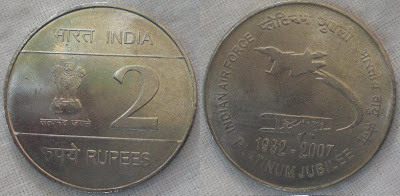
2 rupee air force platinum jubilee
The Indian Air Force ( Bhartiya Vāyu Senā) is the air arm of the armed forces of India. Its primary responsibility is to secure Indian airspace and to conduct aerial warfare during a conflict. It was officially established on October 8, 1932 as an auxiliary air force of the Indian Empire and the prefix Royal was added in 1945 in recognition of its services during the World War II. After India achieved independence from the United Kingdom in 1947, the Royal Indian Air Force served the Union of India, with the prefix being dropped when India became a republic in 1950.

Since independence, the IAF has been involved in four conflicts with neighboring Pakistan and one with the People's Republic of China. Other major operations undertaken by the IAF include Operation Vijay, Operation Meghdoot and Operation Cactus.

The President of India serves as the Commander-in-Chief of the IAF. The Chief of Air Staff, an officer with the rank of Air Chief Marshal, commands the Air Force. There is usually only one serving officer of that rank at any given time in the IAF. One officer has been conferred a 5-star rank, that of Marshal of the Air Force.