Search my blog

Custom Search

For sale

1. iowa/arkansas/ texas/wisconsin state quarter
2.1877 1/2 anna XF-
3.50 years independence unc set
4.Gandhi 10rs
5. unity in diversity(cross) 5 rupees
6.Edward 1/12 anna 1905 UNC
7.1970 1 rupee
8.George V 2 anna AU
9.2004 2rs


If condition is not mentioned then take it to be perfect.

Contact me: koolraj003@gmail.com

"An unidentified coin is a piece of metal. But an identified coin is a piece of history."

"Great collections are built not on money but on passion"

"I can only show you the path. It is you who has to walk on it."

"Collections are not measured in quantity or items you have but in quality and by items missing in collection"

Friday, October 29, 2010

Proof vs UNC coins

Many people have been asking me of late that what is the difference between proof and UNC coins? So I decided to put up a small one on this topic, as I believe that very few people are clear with this concept.Technically speaking, proof and UNC are different qualities. UNC is, by definition, an uncirculated coin which has mint lustre and has lots of shine to it. In case of a 100-year old coin, even if it has some shine it is liable to be classified as UNC. By definition, proof is the highest quality, even higher than UNC. So how can some coin have higher quality than even UNC coin, which is in its original state as it was when it was manufactured. The answer lies in the manufacturing process. The "proof" word is used as it is in dustproof, fireproof etc. by definition, a proof coin has to be at least double struck, and the blanks for preparing the coins are very carefully selected with a selection ratio of less than 20%. After the striking, again the selection ratio is less than 20%. Every sort of precaution has to be taken to ensure the quality of output. Proof coins are also polished and are shinier and have much better finish as compared to UNC coins. There is a higher level of contrast between the raised part and the shallow part in the design of the coin. The raised part is given a matt finish, which is achieved by sand-blasting the die. ordinary UNC coins (which had been circulated but have some lustre or shine usually have some bag marks, which are small scratches made during the handling of the coin, and these can be seen by magnifying the coin. On the other hand, a coin can be called a proof coin only if there are no scratches to be seen on it even when we look at it through a low power microscope.

All that being said, I am not sure whether these quality parameters are followed by Indian mints during production of the coins. It IS a fact that the term proof is a highly misused term, people often do not know the meaning but say they have a proof coin. Even many government mints also misuse the term as the stringent production process is not adhered to. So its hard to say whether the proper process is followed in the Indian mints or not. If you take out a proof coin from its packing and touch the coin, your fingerprints will come on the coin. If there is any such mark on the coin, it cannot be called a proof coin even though it may have the different mint mark. The quality of the proof coin is supposed to be better than that of a UNC coin, definitely not lower. Though if the coin is more than 100 years old, even a coin which does not have shine is called proof because it was made as a proof strike, that would be fair enough. Lets say we are talking of a William mohur or a Victoria sovereign of which a proof strike was made, we wont be getting that quality, but still its fair enough to call it proof because firstly, very very few such coins were made. And secondly, no coin would be existing on this date with the original manufacturing condition totally intact. If these coins have that finish, that is good enough.

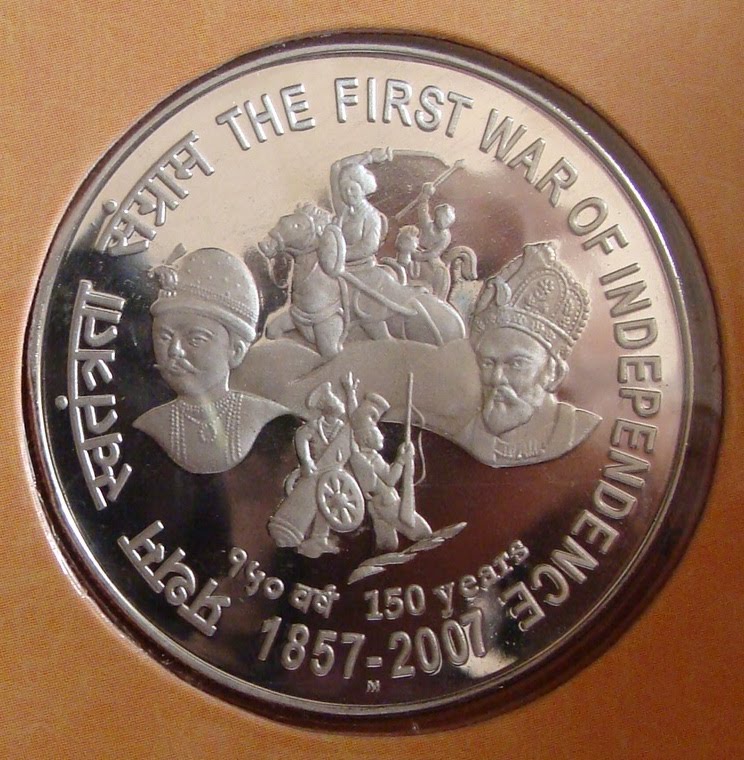
Now we have a look at proof and UNC coins minted on the same theme minted by the Mumbai mint and compare them to see the difference. The theme of these coins is the first war of independence.


First war of independence UNC coin
first war of independence uncNote the diamond mint mark below the date

First war of independence Proof coin
first war of independence proofNote the 'M' mint mark below the date. The 'M' here stands for Mumbai as this coin was minted in the Mumbai mint.

P.S. Kolkata coins have no mint mark, so they cannot be differentiated by the mint mark.

Also, it is noteworthy to see that the proof and UNC coin shown here have difference as the proof coin is having much higher contrast, the raised part is white as it is coated and also it is shinier than the UNC coin.

For investment purpose the proof coins are generally a better bet as the value of proof coin is always higher than a UNC coin. That said, I would suggest people to buy what pleases them, and also the budget is always an essential factor in deciding what to buy and what not to buy.

Wednesday, October 27, 2010

France 25 centimes

25 centime, 1926
france 25 centimes aMetal: copper-nickel
Diameter: 24mm


25 centimes france 1926

Monday, October 25, 2010

British India fakes - I

Victoria rupee, 1879
fake victoria rupee 1879
Edward rupee, 1906
fake edward rupee 1906
fake edward rupee 1906Fakes are highly prevalent in the British coins domain, and the above coins are just a couple of instances of the forgeries. The Victoria rupee is minted in silver, and the Edward shown here is not in silver. A good percentage of the fakes can be identified with just basic knowledge, like the date on a George coin should not be in the 17th century, or sometimes the coin is so ugly that anyone can tell its a fake. But there are some fakes which are made with the help of an original coin and are hard to identify. This is because all the details of such a coin are correct. A die is first made from an original coin, and then the fake is forged from this die. But the experienced person would still know how to differentiate the original from the fake. Here are some pointers:

1)If a coin has been circulated, the wear and tear is always at the highest point. In the forgery, the edges are raised, though sometimes in the original also they can be raised. Remember that if a coin has been used, then its edges are bound to be worn out as they are the highest points.

2)Sometimes a coin which has been worn out to some extent is used to make a die and then a fake is forged. If the original coin is worn out, then the coin forged through this process would also be worn out. If the coin you are looking at is worn out(like the ones shown above), but still looks new and lets say has some luster also, that means its a forgery.

3)If the coin is kept on a glass table face down and then given a spin, and it does spin, that means its a fake. This is because the central part of the coin is the highest point and in the original that part is bound to be worn out. But if the coin is freshly minted, then the centre is a high point and it spins or rotates.

4)If the metal is silver, it can be tested for purity very easily as silver makes a distinctive clinking sound when tossed or when it hits the ground. If the metal is not silver and we are aware that the metal should be silver, then its safe to say that its a fake.


P.S. ujala test and all such things are just bullshit. They use some chemical to turn the blue water colourless and say this coin is original. Do not be fooled by such stupid claims. Also note that I have given the logic for telling the fakes as well. If you start thinking in this manner, then you would not be fooled.

Wednesday, October 20, 2010

France 50 centimes

Seed sower 1/2 Franc, 1975
1/2 franc 1975Weight: 4.5gm
Metal: Nickel
Diameter: 19.5mm
Obverse: The seed sower


50 centimes, 1923
france 50 centimes chamber of commerceMetal: aluminium-bronze
Diameter: 18mm
Obverse: Mercury seated, cadaceus at left, shield on right
Theme: commerce industry


50 centimes, 1938
50 centimes 1938
50 centimes, 1938
france 50 centimes 1938Metal: aluminium-bronze
Diameter: 18mm
Reverse: cornucopias flank denomination

Saturday, October 16, 2010

France 1 Franc - II

1 Franc, chamber of commerce 1922
1 franc chamber of commerce 1922Metal: aluminium-bronze
Obverse: Mercury seated


1 Franc, 1939
france 1 franc 1939Metal: Aluminium-bronze
Diameter: 23mm
Reverse: cornucopias flank denomination and date


1 Franc, 1943
france 1 franc axe 1943Metal: Aluminium
Diameter: 23mm
Obverse: double-bit axe

Tuesday, October 12, 2010

France 1 Franc - I

1 Franc, 1971
france 1 franc seed sower 1971Obverse: the seed sower
Reverse: Lily
Weight:6gm
Metal: nickel
Diameter: 24mm


1 Franc, 1992
france 1 franc 1992 libertyObverse: Liberty bust
Metal: nickel
Diameter: 24mm
Weight: 6gm
Subject: 200th anniversary of the French Republic(1792-1992)


1 Franc, Charles De Gaulle
france 1 franc charles degaulleCharles AndrĂ© Joseph Marie de Gaulle (1890 – 1970) was a French general and statesman who led the Free French Forces during World War II. He later founded the French Fifth Republic in 1958 and served as its first President from 1959 to 1969.

A veteran of World War I, in the 1920s and 1930s de Gaulle came to the fore as a proponent of armoured warfare and advocate of military aviation, which he considered a means to break the stalemate of trench warfare. During World War II, he reached the temporary rank of Brigadier General, leading one of the few successful armoured counter-attacks during the 1940 Fall of France, and then briefly served in the French government as France was falling.

He escaped to Britain and gave a famous radio address, broadcast by the BBC on 18 June 1940, exhorting the French people to resist Nazi Germany and organised the Free French Forces with exiled French officers in Britain.

He gradually obtained control of all French colonies—most of which had at first been controlled by the pro-German Vichy regime—and by the time of the liberation of France in 1944 he was heading a government in exile, insisting that France be treated as an independent great power by the other Allies. De Gaulle became prime minister in the French Provisional Government, resigning in 1946 due to political conflicts. After the war he founded his own political party, the RPF. Although he retired from politics in the early 1950s after the RPF's failure to win power, he was voted back to power as prime minister by the French Assembly during the May 1958 crisis. De Gaulle led the writing of a new constitution founding the Fifth Republic, and was elected President of France, an office which now held much greater power than in the Third and Fourth Republics.

As President, Charles de Gaulle ended the political chaos that preceded his return to power. A new French currency was issued in January 1960 to control inflation and industrial growth was promoted. Although he initially supported French rule over Algeria, he controversially decided to grant independence to that country, ending an expensive and unpopular war but leaving France divided and having to face down opposition from the white settlers and French military who had originally supported his return to power.

De Gaulle oversaw the development of French atomic weapons and promoted a foreign policy of national sovereignty from U.S. and British influence. He withdrew France from NATO military command—although remaining a member of the western alliance—and twice vetoed Britain's entry into the European Community. He travelled widely in Eastern Europe and other parts of the world and recognised Communist China. On a visit to Canada he gave encouragement to Quebec Separatism.

During his term, de Gaulle also faced controversy and political opposition from Communists and Socialists. Despite having been re-elected as President, this time by direct popular ballot, in 1965, in May 1968 he appeared likely to lose power amidst widespread protests by students and workers, but survived the crisis with an increased majority in the Assembly. However, de Gaulle resigned after losing a referendum in 1969. He is considered by many to be the most influential leader in modern French history.

Friday, October 8, 2010

France 2 Franc - II

2 Franc, 1923
2 franc 1923 chmaber commerceThe reverse shows the denomination, "Bon Pour" and "chamber de commerce de france ".

Explanation of "bon pour":
Leave it as such as it is a contract under the french legislation. You can add an explanation or a note :

Being in possession of the money the Notary will be able to deal with the signing of the final deed. He will read through the "acte authentique" and both the vendor and the purchaser will have to initial each page and sign the last page after writing in French "Bon pour accord". This means that you have understood the terms of the document and that you accept it. The Notary should then give you a receipt for the money transferred together with an "attestation de propriete" which certifies that you are the owner of the property conveyed. You will also be given the keys.

The chamber of commerce represents the business community of the country and promotes trade between France and other countries.

the obverse shows the date, Mercury seated with shield in hand and "commerce industrie" or the commerce industry of the country.


2 Franc, 1943
france 2 franc 1943Metal: aluminium
Diameter: 27mm

The axe is associated with France as there was this Germanic tribe, the Franks, in the European migration period, which used short a throwing axe as its primary weapon. They were also known as the throwing axemen.


2 Franc, 1941
france 2 franc 1941Metal: aluminium-bronze
Diameter: 27mm

Thursday, October 7, 2010

France 2 franc - I

2 Franc, 1979
france 2 franc 1979Weight:7.5gm
Metal: nickel
Diameter: 26.5mm


2 Franc, Louis Pasteur
france 2 franc louis pasteur 1895-1995The above coin was released on the death centenary of Louis Pasteur. Louis Pasteur was a world renowned French chemist and biologist. He was born on December 27 1822 in the town of Dole in Eastern France. Pasteur's parents were peasants, his father was a tanner by trade. He spent the early days of his life in the small town of Arbois where he attended school and where it seems that Pasteur did not do very well, preferring instead to go fishing. His headmaster, however, spotted potential in Pasteur and encouraged him to go to Paris to study. So, aged fifteen Pasteur set off for Paris hoping to study for his entrance exams. Unfortunately, the young Pasteur was so homesick that his father had to travel to Paris to bring him home. He then continued to study locally at Besancon, until he decided to try again in Paris. This time he succeeded and went on to study at the Ecole Normale Superieure. Curiously, although the young Pasteur worked hard during his student days he was not considered to be exceptional in any way at chemistry.

In 1847 Pasteur was awarded his doctorate and then took up a post as assistant to one of his teachers. He spent several years teaching and carrying out research at Dijon and Strasbourg and in 1854 moved to the University of Lille where he became professor of chemistry. Here he continued the work on fermentation he had already started at Strasbourg. By 1857 Pasteur had become world famous and took up a post at the Ecole Normale Superieure in Paris. In 1863 he became dean of the new science faculty at Lille University. While there, he started evening classes for workers. In 1867 a laboratory was established for his discovery of the rabies vaccine, using public funds. It became known as the Pasteur Institute and was headed by Pasteur until his death in 1895.

Louis Pasteur was one of the greatest benefactors of mankind. He lived at a time when there was no known cure for diseases like rabies, chicken cholera etc. and he was greatly intrigued by these mysteries. He studied the occurence of these diseases and solved the mystery. He contributed to the development of the first vaccines. He debunked the widely accepted myth of spontaneous generation, thereby setting the stage for modern biology and biochemistry. He described the scientific basis for fermentation, wine-making, and the brewing of beer. Pasteur's work gave birth to many branches of science, and he was singlehandedly responsible for some of the most important theoretical concepts and practical applications of modern science.

Pasteur's achievements seem wildly diverse at first glance, but a more in-depth look at the evolution of his career indicates that there is a logical order to his discoveries. He is revered for possessing the most important qualities of a scientist: the ability to survey all the known data and link the data for all possible hypotheses, the patience and drive to conduct experiments under strictly controlled conditions, and the brilliance to uncover the road to the solution from the results.

On the discipline of rigid and strict experimental tests he commented, "Imagination should give wings to our thoughts but we always need decisive experimental proof, and when the moment comes to draw conclusions and to interpret the gathered observations, imagination must be checked and documented by the factual results of the experiment."

The famous philosopher Ernest Renan said of Pasteur's method of research, "This marvelous experimental method eliminates certain facts, brings forth others, interrogates nature, compels it to reply and stops only when the mind is fully satisfied. The charm of our studies, the enchantment of science, is that, everywhere and always, we can give the justification of our principles and the proof of our discoveries."

The pattern of logic in Pasteur's scientific career and the brilliance of his experimental method are well documented. It all started from studying crystal structure. As a student at the Ecole Normale, Pasteur observed that the organic compound tartrate, when synthesized in a laboratory, was optically inactive (unable to rotate the plane of polarized light), unlike the tartrate from grapes, because the synthetic tartrate is composed of two optically asymmetric crystals. With careful experimentation, he succeeded in separating the asymmetric crystals from each other and showed that each recovered optical activity. He then hypothesized that this molecular asymmetry is one of the mechanisms of life. In other words, living organisms only produce molecules that are of one specific orientation, and these molecules are always optically active.

This hypothesis was tested again by utilizing a synthetic tartrate solution that had been contaminated with mold. He found that this solution became more optically active with time and concluded that the mold was only utilizing one of the two crystals. Later in his career, he was approached with a contamination problem in alcoholic fermentation, which was thought to be an entirely chemical process at the time. After careful examination, he found that the fermenting solution contained optically active compounds and concluded that fermentation was a biological process carried out by microorganisms. This hypothesis, called the germ theory, was followed by many elegant experiments that showed unequivocally the existence of microorganisms and their effect on fermentation.

The germ theory was the foundation of numerous applications, such as the large scale brewing of beer, wine-making, pasteurization, and antiseptic operations. Another significant discovery facilitated by the germ theory was the nature of contagious diseases. Pasteur's intuited that if germs were the cause of fermentation, they could just as well be the cause of contagious diseases. This proved to be true for many diseases such as potato blight, silkworm diseases, and anthrax. After studying the characteristics of germs and viruses that caused diseases, he and others found that laboratory manipulations of the infectious agents can be used to immunize people and animals. The discovery that the rabies virus had a lag-time before inducing disease prompted the studies of post-infection treatment with weakened viruses. This treatment proved to work and has saved countless lives.

All of these achievements point to singular brilliance and perseverance in Pasteur's nature. His work served as the springboard for branches of science and medicine such as stereochemistry, microbiology, bacteriology, virology, immunology, and molecular biology. Moreover, his work has protected millions of people from disease through vaccination and pasteurization.

Tuesday, October 5, 2010

France 5 Franc

5 Franc, 1945
france 5 franc 1945Metal: Nickel
Diameter: 31mm
Obverse: laureate head


5 Franc, 1972
france 5 franc 1972Metal: nickel clad copper nickel
Diameter: 29mm
Obverse: the seed sower

Monday, October 4, 2010

Commonwealth games Delhi 2010 booking

Commonwealth games set booking
commonwealth games delhi 2010 set bookingThe set of commonwealth games Delhi 2010 consisting of 3 coins: Rs 100, Rs 5 and Rs 2 was released on the eve of the the games. The above picture is an advertisement taken from the Times of India dated 3rd October, 2010 (Sunday). Along with the commonwealth games set, rebooking is also open for 3 different sets: Rabindranath Tagore, Perarignar Annadurai and Rajendra Prasad.

P.S. Open the image in a new tab or new window, or save to your computer to see a clear picture.

Saturday, October 2, 2010

France 10 Franc - II

10 franc, 1986
10 franc 1986On the obverse the words "liberte, egalite, fraternite" can be seen which mean freedom, equality and brotherhood.


10 franc, 1948
france 10 franc 1948Metal: copper-nickel
Diameter: 26mm


10 franc, 1951
france 10 franc 1951Metal: aluminium-bronze
Diameter: 20mm

Friday, October 1, 2010

Racket of coin con men caught in Kolkata

The Indian coin market is in the growth stage, and along with a boom in the investors, there is also a surge in the number of related forgeries and con men. We need to be on our guard against such people and proper knowledge can save us from being conned. The number of cases of fraud is on the rise and now even the police has started to come into the picture and we may see some high profile cases in the time to come. The following is an article from the Times Of India, Kolkata dated 17th September, 2010. Read on:

KOLKATA: It was an audacious con job, and it almost worked.

On Wednesday, luck ran out for a group of con artists who had chalked out an elaborate plan to dupe an unsuspecting victim of crores. The players involved are from various parts of the country, and though their Kolkata connection is not yet clear, the sequence of events that led to their arrest was played out in the city.

It all started when fruit exporter Danajia Prabhu of Andhra Pradesh wanted to act as a middleman in a deal involving "rarest of the rare antique coins" supposedly worth crores. Preliminary investigation revealed that he came in touch with a 27-year-old man called Atik Ahmed alias Samir of Bangalore, who claimed to have access to four "ujala blue coins" that could turn blue water colourless. Samir also claimed that the coins could fetch up to Rs 2,000 crore in the international market.

Samir asked Prabhu to look for a client while we would get in touch with the person who had the coins. It was agreed that Prabhu would get 15% of the sale price. Samir also suggested that Prabhu look for the client on the internet using the key words "ujala blue coin".

Prabhu found an "interested" person on a website. Berlin-based "Mr Muller of Elloco Cone Foxy Metal" was reportedly willing to pay any price to get the coins. Prabhu immediately shot off a mail to Muller, and got a reply saying he should contact the latter's India "representatives", Ugrasen Sahu and Gaurav Prasad. Accordingly, Prabhu contacted the duo and they decided that a demonstration of the coins to prove their authenticity would be held at a star hotel in Kolkata on August 11. At the same time, Samir informed him that he had established contact with the person Vikas Singh of Jamshedpur who had the coins.

Prabhu and his brother Dayanidhi Damodaran then decided to meet Samir and Vikas. However, just before the trial, Ugrasen and Gaurav called up Prabhu and told him that they were stuck in Delhi due to some urgent work. They advised him that he must not lose the opportunity and should "book" the coins after checking their authenticity. To ensure that there was no foul play involved, they asked Prabhu to take his own water and blue dye for the trial.

Samir, meanwhile, told Prabhu that he had got another client for the coins. So, even if Prabhu was not interested, he would not have any problems selling the " magic coins".

The trial, though, was held as planned but with only one coin. It was found that the coin could indeed turn blue water colourless. Prabhu told Ugrasen and Gaurav that the test was successful and the coins were genuine. He also told them that Samir had got another client and was ready to sell the coins for Rs 6 crore. Ugrasen and Gaurav then asked Prabhu to arrange for Rs 2 crore to "book" the coin and would come to Kolkata soon with Rs 6 crore.

Prabhu was given the bait that whatever he invested as booking amount would be his share and multiply when the final deal would be struck with Muller. Prabhu arranged for Rs 1.1 crore that night and gave it to Samir and Vikas. The coin was kept in a vault. One of the keys was with Samir while the other was given to Prabhu. It was agreed that all four coins would be handed over to Ugrasen and Gaurav through Prabhu only after the final payment. August 28 was fixed as the date for the final deal. It was also decided that all four coins would be brought that day.

The venue of the deal was another star hotel in Kolkata. Samir then received a mysterious call, after which he told the others that Vikas who was bringing the coins had met with an accident near Krishnagar and the coins could not be found. He, though, assured Prabhu that the coins could be "located" through a puja that would cost Rs 5,00,501. Prabhu paid up this amount as well. The puja was conducted and Prabhu was made to believe that some villagers in Krishnagar had the coins.

It was decided that the villagers would be asked to come to the city to hand over the coins on Wednesday. Accordingly, three villagers Baidyanath Sahu, Sashidhar Kumbhakar and Chaitanya Kumbhakar came to the hotel. Vikas, Ugrasen, Samir and Gaurav were also present.

The villagers asked for Rs 6 crore as payment for the coins. Immediately, Ugrasen and Gaurav took out Rs 4 crore and asked Prabhu to pay the remaining Rs 2 crore. It was then that Prabhu suspected foul play.

On the pretext of arranging the money, Prabhu headed for Alipore police station and lodged a complaint there. Immediately, officers of the detective department were alerted. They swung into action and found that all seven persons Samir, Vikas, the three villagers, Ugrasen and Gaurav were involved in the same racket. Police said the three villagers were actually residents of Mayurbhanj in Orissa. Also, in all probability, the website was created by this gang.

While arresting the accused after barging in as plainclothesmen, police found bundles of fake Indian currency on them. A chemical, which was used to turn blue water colourless, was also seized. Police are now trying to find out if the German buyer actually exists. The gang's city links are also under the scanner.

The seven accused were remanded in police custody till September 28, said DC DD (special) Vishal Garg.


It is my request to everyone: collector or otherwise, that please analyze every aspect carefully before making an investment or spending a huge amount on coins. DO NOT buy any expensive coin unless you have the knowledge and are absolutely sure that the coin is having a huge value as per the price asked, and buy only from some trustworthy person and not from some unknown person. These may seem like very basic things but people do get cheated of their hard earned money (which is quite sad) as the con men and fakers have a big network like the one on the above case, and the unsuspecting person gets caught in their web. It is always advisable to consult some knowledgeable collector before buying.

Please remember that lakhs or crores of rupees cannot be earned overnight. Yes, it is possible to earn lots of money through coins but firstly you need to have an interest and study the market for at least one year with interest so as to gain the knowledge. If you invest without knowledge or with half knowledge, then it is not a chance that you will be in loss; it is a GUARANTEE that you will be in loss.