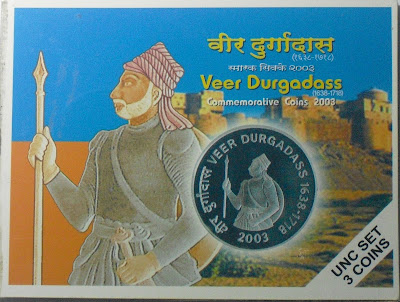
Veer Durgadass UNC set cover
 Obverse
 Reverse
 Durgadass 100 rupee

 Durgadass 10 rupee

 Durgadass 1 rupee
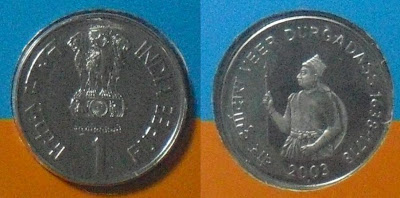 Composition

Early life
Durgadas was a suryavanshi Rathore Rajput, who belonged to the Karnot branch of the Rathore clan. Askaran Rathore, a Rajput general in the army of Maharaja Jaswant Singh, was his father. As his mother lived away from Jodhpur as she did not get along with her husband and Durgadas grew up in a small village.
A camelherd who was rearing the herds of the Maharaja, ventured into the boy Durgadas's fields. Durgadas asked the camel herd to take his herd away as he was concerned about his fields but the camelherd paid no heed. Durgadas killed him with his sword. Durgadass was summoned by Maharaja Jaswant Singh when when word of this reached him. Durgadas told him that the royal herd of camels was giving Jaswant Singh a bad name by destroying the crops of ordinary people. The Maharaja gave Duragdass an appointment in the army as he was impressed with Durgadas's uprightness.
Saving Ajit Singh
Maharaja Jaswant Singh, ruler of Marwar, died in 1679 without immediate male heirs. However, two of his wives were pregnant at the time of his death. Seeing the opportunity, the mughal emperor Aurangzeb to intervene; he appointed a Muslim to rule over Marwar, which upset the Rathod clan a great deal. One of Jaswant Singh's pregnant widows gave birth, in due course, to a male child, who was named Ajit Singh. After the birth of a heir, prominent people of Marwar, including Durgadas, went to Delhi along with the infant Ajit Singh and asked Aurangzeb that the infant be confirmed in his late father's estates and titles. Aurangzeb did not absolutely refuse, but suggested that Ajit grow up in Delhi in front of him.
The nurturing of the head of the Rathod clan in Aurangzeb's staunchly muslim household was not acceptable to the clan. It is said that crown prince Ajit Singh along with his mother was staying at a place called "Bhuli Bhatiyari" near Jhandewalan of modern Delhi. Durgadas and others of the delegation resolved upon smuggling Ajit Singh out of Delhi. Durgadas and his 300 men, notable among them Thakur Mokam singh Balunda and Mukand Das Khichi made a plan. According to the plan Mokam Singh Balunda's wife Bagheli put her infant girl, in place of Ajit Singh. As they approached the outskirts of the city, the mughal guards fell in hot pursuit and Durgadas and his companions had to make their escape while fighting hand-to-hand battle with the much larger mughal army. Every now and then, some 15-20 Rajputs would fall behind to check the mughal pursuers, thus sacrificing themselves for the bigger cause. In this battle Mokam singh Balunda, his son Hari singh Balunda got injured, but they managed to keep distance between the forward party and the Mughals.Among them Mokam singh Balunda's wife Bagheli Rani. This continued till the evening; and in the end Durgadas managed to escape with the infant Ajit Singh even though he was left with just seven men out of the 300 he started with. Mokam Singh's wife Bagheli ji kept Maharaja Ajit singh at Balunda for almost one year, Later, he was moved to the safety of Aravali hills near Abu Sirohi, a remote town on the southern fringes of Marwar, and grew up in anonymity.
Marwar remained under the direct rule of a Mughal governor for 20 years hence.Durgadas carried out a relentless struggle against the occupying forces. Durgadas took advantage of the disturbances following the death of Aurangzeb in 1707 to seize Jodhpur and eventually evict the occupying Mughal force. Ajit Singh was proclaimed Maharaja of Jodhpur. He rebuilt all the temples that had been desecrated by the occupying Muslims.
Character
Aurangzeb's son Sultan Muhammad Akbar rebelled against his father. Durgadas was among those who extended aid to him in the rebellion. But Akbar was exiled, where he died later and the plan failed. He left his children in the custody of Durgadas. Aurangzeb became extremely anxious to get his grandchildren back. He requested Durgadas, who agreed to send them to Aurangzeb. When the children arrived, Aurangzeb asked a Qazi to start teaching them the Quran. On hearing this, his little granddaughter began reciting ayats from the holy book. Aurangzeb was left dumbfounded. On being asked, his granddaughter told him that while she was in Durgadas's custody, a Qazi had been engaged to take care of their religious training.
Such was Durgadas. Till today, people in Rajasthan pray: Mayee ehra poot jan jehara DURGADAS, baandh mundaso rakhiyo bin thambe aakash. (Mother, give birth to a son just like Durgadas,who stopped the flooding dam of Moghuls (the Moghul Army) without any support (i.e. single handedly)).
Last breath
So, having kept his word that he gave to Jaswant Singh, left Jodhpur to live in Sadri, Udaipur, Rampura, Bhanpura for some time and then left to worship Mahakaal at Ujjain. On 22nd November 1718, on the banks of the Sipra at Ujjain, Durgadas passed away at the age of 81 years, his beautiful canopy in red stone is still at the Chakrathirth, Ujjain, which is pilgrimage for all freedom fighters and rajputs. Veer Durgadas thus left behind a sterling example of loyalty, chivalry and courage.


 The Dandi March set of statues in Delhi.
 Civil disobedience movement
 50 years of independence Unc set obverse
 50 years of independence 50 rupee obverse
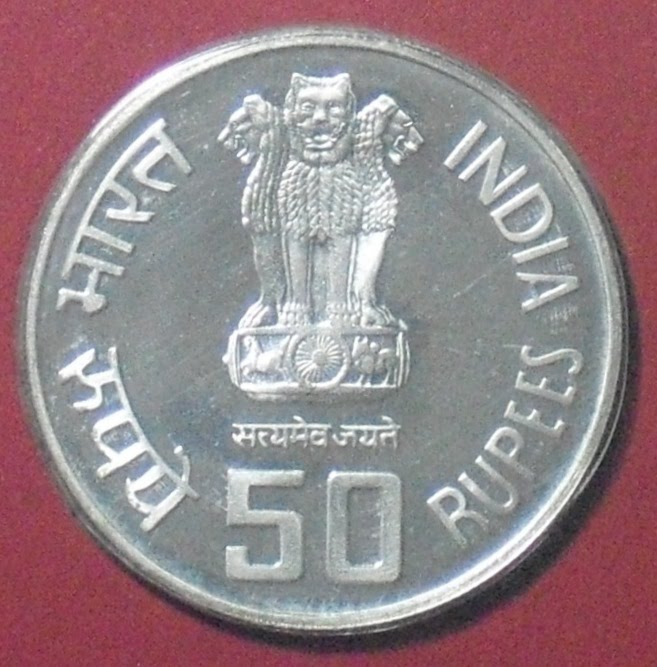 Reverse
 Composition


