Search my blog

Custom Search

For sale

1. iowa/arkansas/ texas/wisconsin state quarter
2.1877 1/2 anna XF-
3.50 years independence unc set
4.Gandhi 10rs
5. unity in diversity(cross) 5 rupees
6.Edward 1/12 anna 1905 UNC
7.1970 1 rupee
8.George V 2 anna AU
9.2004 2rs


If condition is not mentioned then take it to be perfect.

Contact me: koolraj003@gmail.com

"An unidentified coin is a piece of metal. But an identified coin is a piece of history."

"Great collections are built not on money but on passion"

"I can only show you the path. It is you who has to walk on it."

"Collections are not measured in quantity or items you have but in quality and by items missing in collection"

Tuesday, November 30, 2010

Nigeria Kobo

Nigeria coat of arms
nigeria coat of arms


1 kobo 1974
nigeria 1 kobo 1974Weight: 2.57gm
Metal: bronze
Diameter: 17mm
Ruler: Elizabeth II
Reverse: value flanked by oil derricks


5 kobo, 1973
nigeria 5 kobo 1973Metal: copper-nickel
Reverse: cocoa beans with denomination

The Nigerian connection with cocoa is vast and has been there for a long period of time. It has been documented by a number of authors. The impact of cocoa on the Nigerian economy is big as Nigeria is a major exporter of cocoa and cocoa products, and cocoa is a major source of revenue to the cocoa producing states. The crop also provides employment to a very significant percentage of the Nigerian population, either directly or indirectly.


10 kobo, 1973
nigeria 10 kobo 1973Metal: copper-nickel
Diameter: 2.8mm
Reverse: value with palms

Nigeria has always been a major producer of palm oil for long and so this tree has its place in Nigeria.

As of the present, the Nigerian agriculture is languishing because the government is giving most of the focus on the crude industry post the discovery of natural oil resources in the area. Now they are no longer major producers of crops like cocoa, palm oil etc.

The Coat of Arms of Nigeria has a black shield with two white stripes that come together, like the letter Y. These represent the two main rivers flowing through Nigeria: the Benue River and the Niger River. The black shield represents Nigeria's good earth while the two horses on each side represent dignity. The eagle represents strength, while the green and white bands on the top of the shield represent the rich agricultural land of the inspiring country. The yellow flowers at the base (incorrectly shown as red in the image) are Costus Spectabilis, Nigeria's national flower.

Friday, November 26, 2010

Italy Lira - II

10 Lira, 1968
italy 10 lira 1968Weight: 1.6gm
Metal: aluminium
Diameter: 23.25mm


20 Lira, 1958
italy 20 lira 1958Weight: 3.6gm
Metal: Aluminium-Bronze
Diameter: 21.25mm
Obverse: wheat sprigs within head
Reverse: oat leaves by value


50 Lira, 1978
italy 50 lira 1978The 50 Lira coin shows Vulcan, the god of fire on the obverse. Vulcan is associated with beneficial and hindering fire, and also the fire of volcanoes which comes from beneath. Fire has always been worshipped as it can cause destruction to the harvested grain, but can also be beneficial when we are facing an opponent.

Vulcan
vulcan god of fire

Tuesday, November 23, 2010

Italy Lira - I

100 Lira, 1977
italy 100 lire 1977Weight: 8 gm
Metal: stainless steel
Diameter: 27.8mm


200 Lire, Genova stamps convention 1992
italy 200 lira genova stamps expo 1992This one was released on the occasion of the 1992 Genova stamps convention.


200 Lire, 1979
italy 200 lire 1979Weight: 5gm
Metal: Aluminium-Bronze
Diameter: 24mm
Reverse: Value within gear


500 Lire, 1984
italy 500 lire 1984Do you think that this one is another run-of-the-mill coin? Not many would know I think, but this is the first bimetallic coin to be widely used in circulation. The cost of making a bimetallic coin is higher than a normal coin, so mostly only the higher value coins are bimetals. The Reverse shows the Plaza Di San Marco.

Plaza Di San Marco, Venice
plaza di san marco venice

Saturday, November 20, 2010

Italy Euro

1 Euro, 2002
italy 1 euro 2007Are you thinking that you have seen this figure umpteen times, but do not know what it is? This is the famous sketch of Vitruvian man by the Italian artist Leonardo Da Vinci. The drawing illustrates Da Vinci's representation of the ideal proportions of the human body, as it was postulated by the Roman architect Marcus Vitruvius in 1BC, and after whom this sketch is so named. Although Da Vinci could not give any scientific assertion as to why the ideal proportions of the human body should be as shown, but a number of artistes from generations following him have given their postulates regarding this sketch. In this sketch, the navel is taken as the centre of our body and a circle is drawn from there, with the radius extending from the navel to the tip of the feet. We also notice a square drawn with the length of its side from the feet to the head, and just enclosing the extended arms.

The Vitruvian man by Leonardo Da Vinci
vitruvian man leonardo da vinci

Parnassus by Raphael
the parnassus by RaphaelDante is shown by the yellow arrow. The center figure is Apollo and the mural shows nine muses, nine poets from eras past and nine contemporary poets including Dante Alighieri.

2 Euro, 2002
italy 2 euro 2002The Italy 2 Euro coin shows the face of Dante Alighieri, as it was frescoed posthumously by the celebrated Italian painter Raphael in his painting titled 'Parnassus'. This fresco was painted as a mural or a painting on a wall to decorate the walls of the Apolistic palace in the Vatican. The painting shows the mythical mount Parnassus where Apollo resides. Apollo is surrounded by nine muses, nine poets of ages past and nine contemporary poets. Dante Alighieri is known for his work 'The Divine Comedy'. The movie Dante's inferno is based on the first part of the epic known as 'The Divine Comedy'. Inferno here refers to hell and Dante's Inferno allegorically tracks the journey of Dante through what is the medieval concept of hell.

Dante in 'Parnassus'
dante alighieri by raphael
2 Euro, world food program

italy 2 euro world food program

Wednesday, November 17, 2010

Euro: Italy cents - II

1 cent, 2007
italy euro 1 cent 2007The one cent coin shows the Castel Del Monte, a 13th century castle situated in the Apulia region of Southeast Italy. It was built by the Holy Roman emperor Frederick II around 1250. It does not have a moat or drawbridge and apparently it was never intended as a defensive fortress.It was completed in 1240 and was used primarily as a hunting lodge by Frederick until his death in 1250. It was later turned into a prison, used as a refuge during a plague, and finally fell into disrepair. It originally had marble walls and columns, but all were stripped by vandals.

The fortress is an octagonal prism with an octagonal bastion at each corner. Each floor has 8 rooms and an eight-sided courtyard occupies its centre.The octagon is thought to be an intermediate symbol between a square (representing the earth) and a circle (representing the sky). Frederick II may have been inspired to build to this shape by either the Dome of the Rock in Jerusalem, which he had seen while on Crusade, or by the Palace Chapel of Aachen Cathedral.

Castel Del Monte

castel del monte

2 cent, 2008

italy euro 2 cent 2008The Italy 2 cent coin shows the Mole Antonelliana of Turin.A Symbol of the city and daring building, it was begun in 1862 by Alessandro Antonelli as a Jewish temple; after a period of stop, the works began again in 1878 with the construction over the vault of a granite room, on which a lantern made of two floors and then a high cone which transforms the square plan into a circle plan are based.

A series of conic and cylindrical elements completes the already high spire; these elements end with a cusp of pyramidal shape on and octagonal plan, realised in two separate parts.
A genius with wings on the spire ends the works in 1889, when the direction of the building yard is passed to Costanzo Antonelli, son of the dead architect.

The Mole, with its 163,35 metres high, is the tallest brick building in the world.At the time of building it was the tallest building in the world and to date its the tallest in the city.In August 1904 an hurricane knocked over the statue, substituted by a star, and in 1953 a storm knocked over more than 40 metres of the cusp, substituted between 1958-61 by a metal structure covered in stone, also reinforcing the inferior structures.

Inside a room in square plan is covered by a nerved pavilion vault, outside the four sides take an homogeneous configuration.

A panoramic lift leads to the little temple under the spire, from which you can enjoy a beautiful city landscape and of the surrounding mountains.

The Mole is the actual seat of the National Museum of Cinema.

Mole Antonelliana, Turin
mole antonelliana

5 cent, 2006
italy euro 5 cent 2006The Italy 5 cent coin shows the Flavius amphitheater on the obverse, more commonly known as the Colosseum of Rome. The Colosseum was created for the purpose of gladiatorial contests and public spectacles like reenactment of famous battles, animal hunts, executions, mock battles, chariot races etc. The Colosseum as we know it today had some predecessors made of wood. The amphitheater had to house thousands of people and was susceptible to giving in under pressure and fire was always a hazard. After the reign of Nero, it was the Flavian dynasty which started the construction of the amphiteatre in 72 AD in marble and such more stable materials, and it was completed in 80AD. After the name of the dynasty it came to be known as the Flavius amphiteatre. The name Colosseum was given because of the colossal statue of Nero at the entrance.

Although the Southern side of the elliptical structure was destroyed in an earthquake long back and today it is in ruins, it remains an iconic symbol of imperial Rome, one of the greatest works of Roman architecture and engineering and also one of the major tourist attractions in Rome.

The Colosseum of Rome
colosseum

Sunday, November 14, 2010

Euro: Italy cents - I

10 cent, 2007
italy euro 10 cent 2007The picture shown on this coin is from Alessandro Botticelli’s “Birth of Venus” (1485). In the painting, the goddess Venus [or Aphrodite as she is known in Greek mythology] emerges from the sea upon a shell in accordance with the myth that explains her birth. Her shell is pushed to the shore from the winds produced by the Zephyr wind-gods amid a shower of roses. As the goddess is about to step on the shore, one of the Nymphs reaches out to cover her with a purple cloak. This painting is among the most treasured masterpieces of the Renaissance.

"Birth of venus" by Sandro Botticelli
birth of venus by sandro botticelli
"Unique forms of continuity in space" by Umberto Berlusconi
unique forms of continuity in space20 cent, 2002
itlay euro 20 cent 2002The Italy 20 cent coin depicts a bronze sculpture made by Umberto Berlusconi, which is titled "Unique Forms of Continuity in Space". It is seen as an expression of movement and fluidity. Boccioni rejected traditional sculpture and depictions to create this piece and it is seen as a masterpiece of Futurism.

Unique Forms of Continuity in Space depicts a human-like figure seemingly flying or gliding through air. A clinging drapery whips back around his legs, giving the sculpture an aerodynamic and fluid form. Instead of a traditional pedestal, the figure is only bound to the ground by two blocks at his feet. The figure is also armless and without a discernibly real face.

50 cent, 2002
italy euro 50 cents 2002This coin shows the figure of the Roman emperor Marcus Aurelius on horseback. Marcus Aurelius Antoninus was Roman Emperor from 161 to 180. He ruled with Lucius Verus as co-emperor from 161 until Verus' death in 169. He was the last of the "Five Good Emperors", and is also considered one of the most important Stoic philosophers. Stoicism was a school of Hellenistic philosophy founded in Athens by Zeno of Citium in the early 3rd century BC. The Stoics considered destructive emotions to be the result of errors in judgment, and that a sage, or person of "moral and intellectual perfection," would not suffer such emotions.

During his reign, the empire defeated a revitalized Parthian Empire; Aurelius' general Avidius Cassius sacked the capital Ctesiphon in 164. Aurelius fought the Marcomanni, Quadi, and Sarmatians with success during the Marcomannic Wars, but the threat of the Germanic Tribes began to represent a troubling reality for the empire. A revolt in the east led by Avidius Cassius failed to gain momentum and was suppressed immediately.

Marcus Aurelius' work Meditations, written in Greek while on campaign between 170 and 180, is still revered as a literary monument to a government of service and duty. It serves as an example of how Aurelius approached the Platonic ideal of a philosopher-king and how he symbolized much of what was best about Roman civilization.

Saturday, November 13, 2010

France 1 centime

1 centime, 1968
france 1 centime 1968Metal: chrome-steel
Obverse: cursive legend surrounds grain sprig

Friday, November 12, 2010

France 20 centimes

20 centimes, 1942
france 20 centimes 1942Metal: zinc
Obverse: grain sprigs flank center hole

Monday, November 8, 2010

UNC set: Gur-ta-gaddi

ਆਗਿਆ ਭਈ ਅਕਾਲ ਕੀ ਤਬੀ ਚਲਾਇਓ ਪੰਥ ।
ਸਭ ਸਿਖਨ ਕੋ ਹੁਕਮ ਹੈ ਗੁਰੂ ਮਾਨਿਯੋ ਗ੍ਰੰਥ ।
ਗੁਰੂ ਗ੍ਰੰਥ ਜੀ ਮਾਨਿਯੋ ਪ੍ਗਟ ਗੁਰਾਂ ਕੀ ਦੇਹ ।
ਜੋ ਪ੍ਭ ਕੋ ਮਿਲਬੋ ਚਹੈ ਖੋਜ ਸ਼ਬਦ ਮੈਂ ਲੇਹ ।

Gur-ta-gaddi cover
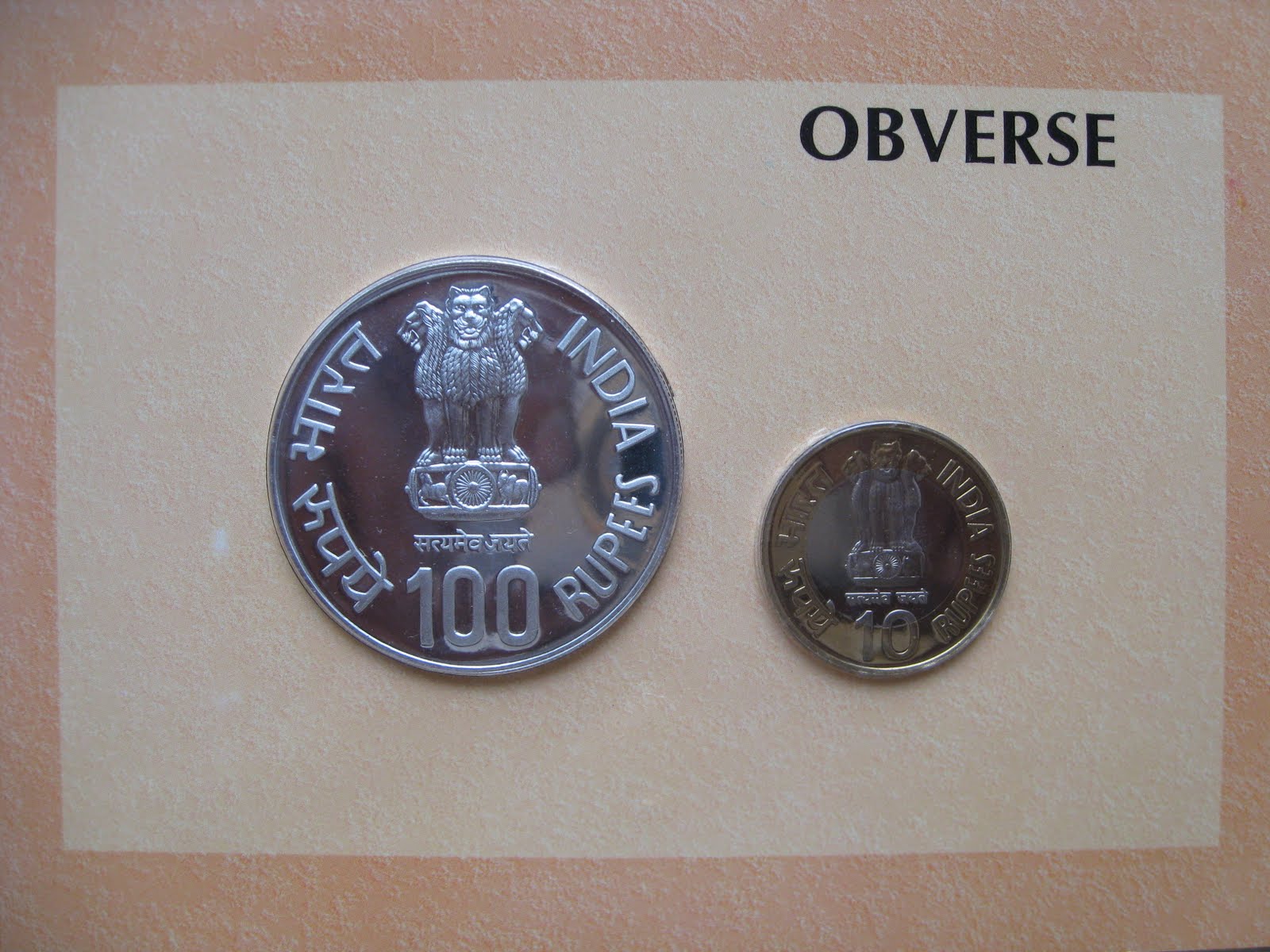
gur ta gaddi unc set coverGur-ta-gaddi obevrse
gur ta gaddi unc set obverseReverse
gur ta gaddi unc set reversegur-ta-gaddi 100 rupee obverse
gur ta gaddi 100rupee obverse100 rupee reverse
gur ta gaddi 100 rs reverseThe reverse shows the Harmandir Sahab,( Punjabi: ਹਰਿਮੰਦਰ ਸਾਹਿਬ) meaning "Temple of God," or Golden Temple, also Darbar Sahib (Punjabi: ਦਰਬਾਰ ਸਾਹਿਬ), is the holiest shrine of Sikhism.

In 1577, the fourth guru of the Sikhs Guru Ram Das ji excavated a tank which was later on expanded, and also gave name to the city that developed around it: Amritsar(meaning pool of the nectar of immortality). In due time, a splendid Sikh edifice, the Harmandir Sahab was constructed in the middle of the pool and it became the supreme sanctum of Sikhism.Its sanctum came to house the Adi Granth comprising compositions, Sikh values, philosophies and teachings of the Sikh Gurus and other saints of Guru Nanak's time, e.g. Ravidas a Hindu Guru, Baba Farid a Sufi Sant (Saint) and Kabir, all of whom the Sikhs refer to as the Bhagats. The compilation of the Adi Granth was started by the fifth Guru of the Sikhs, Guru Arjan Dev.

The Golden Temple has been attacked and destroyed a number of times by various forces over the centuries, including attacks by the Mughals and the Afghan invader Ahmad Shah Abdali who went to the point of blowing up the temple with gunpowder and filling the sarovar (sacred pool) with the carcasses of slaughtered cows and people; but each time the attackers got destroyed and the temple was revived like a phoenix.

Ahmad Shah Abdali invaded the Indus valley and India a total of eight times(1747-1764). His fear was such that the Mughals had to recognize his suzerainty over Kashmir and Punjab and could do nothing from putting up a puppet ruler on the Mughal throne. Even the united Marathas under Sadashiv Bhau, perhaps the strongest force in India at that time, were defeated decisively in the third battle of Panipat(perhaps India's equivalent of Waterloo, given that Pani means water), which was fought over a twelve kilometer battlefront. Abdali had the largest Islamic empire in the world at that time. It was in such a time that the Sikhs rebelled a number of times against Abdali, and finally the Afghan forces under Abdali's general Jahan Khan were ANNIHILATED by the Sikh army under Jassa Singh Ahluwalia. Abdali died in 1773 from a cancerous wound he got in 1764, which is said to have been caused by a flying brick when he was going about demolishing the Golden temple.

Any mention of battle with Jahan Khan and the Afghans will not be complete without the name of Shaheed (martyr) Baba Deep Singh ji (1682-1757) , whose valor in battle is unprecedented and still unsurpassed. On hearing that the Afghans had defiled the temple and Amritsar, even in his age of 76 he picked up his 15Kg Khanda(two edged sword) and took a pledge to drive the Afghans out of Amritsar and teach them a fitting lesson. Baba Deep Singh ji gathered a total of above 5000 Sikh soldiers and then drew a line in the sand with his khanda, and asked only those who were willing to fight and die to cross the line.

All the assembled Sikhs crossed the line eagerly. Then he recited the shabad:

ਜਓ ਤਓ ਪ੍ਰੇਮ ਖੇਲਨ ਕਾ ਚਾਓ, ਸਿਰ ਧਰ ਤਲੀ ਗਲੀ ਮੇਰੀ ਆਓ ||
ਇਤ ਮਾਰਗ ਪੈਰ ਧਰੀਜੈ, ਸਿਰ ਦੀਜੈ ਕਾਨ ਨਾ ਕੀਜੈ ||
"jao tao prem khelan ka chao, sir dhar tali gali meri ao ||
it maarag pair dhareejai, sir deejai kan na keejai ||"

(meaning : Those who wish to play the game of love (to follow the Sikh path), come to me with your head in your palm. If you wish your feet to travel this path, don't delay in accepting to give your head.)

A fierce battle was fought between the Sikh and Afghan forces, and Babaji's head was cut off in a duel when he was still far from the temple. When some nearby Sikh reminded him of his pledge, the miracle which then manifested has no precedent or occurred ever after. Babaji supported his head with his left hand and with his right, he swung his khanda with such ferocity and skill that to flee was the best course of action that the opposing forces could take. The very sight of such a spectacle was enough to rend the hearts of the Afghans with fear. Then fighting along the way, he reached Amritsar where he offered his head and breathed his last.

In the last century one of the most tragic events, in the Operation Bluestar in June 1984, the Indian army mounted an attack which caused severe damage to the Akal Takhat and the whole complex. A bullets or a piece of shrapnel hit and killed one Sewadar inside the temple itself). Even the SGGS(sri guru granth sahab) being read by a Granthi was pierced by a bullet. The beautiful marble slabs that cover the Parikarma (the promenade that surrounds the Sarovar) were cut deeply, some even broken as the Indian army called in heavy tanks whose tracks cut deeply into the marble. Besides being damaged by the tanks, the blood of the attackers, the occupiers and unknown numbers of innocent pilgrims flowed from the bodies that covered the walkway, staining the marble and filling the mortar between each slab. As of now, the shrine is in its utmost glory and is adorned with gold.

Below the picture of the Golden temple, the inscription reads: "Bani Guru Guru hai Bani", which means that the hymns written in the Guru Granth Sahab ji have to be regarded as the Guru (or teacher).


Gur-ta-gaddi bimetal 10 rupee
gur ta gaddi 10 rupee
This set was released on the occasion of 300 years of gur ta gaddi, or the consecration of Guru Granth Sahab, the holy book of the Sikhs, as the last Sikh guru. This happened at Nanded in Maharshatra with the parlok gaman(or death) of the last Sikh guru to be embodied, Guru Gobind Singh. In his last moments he proclaimed Guru Granth Sahab to be the embodiment of the ten gurus. Guru Gobind Singh Ji's last sermon:

ਆਗਿਆ ਭਈ ਅਕਾਲ ਕੀ ਤਬੀ ਚਲਾਇਓ ਪੰਥ ।
ਸਭ ਸਿਖਨ ਕੋ ਹੁਕਮ ਹੈ ਗੁਰੂ ਮਾਨਿਯੋ ਗ੍ਰੰਥ ।
ਗੁਰੂ ਗ੍ਰੰਥ ਜੀ ਮਾਨਿਯੋ ਪ੍ਗਟ ਗੁਰਾਂ ਕੀ ਦੇਹ ।
ਜੋ ਪ੍ਭ ਕੋ ਮਿਲਬੋ ਚਹੈ ਖੋਜ ਸ਼ਬਦ ਮੈਂ ਲੇਹ ।

"agya bhai akal ki tabhi chalayo panth,
sabh sikhan ko hukam hai guru manyo granth.
guru granth ji manyo pragat guran ki deh.
jo prabh ko milbo chahe khoj shabad me le."

This means that the panth or sect was started under orders of the almighty. All the Sikhs are hereby ordered to accept Guru Granth Sahab as their Guru. Guru Granth sahab has to be regarded as representing the guru's body. Those who wish to meet the Guru can find their way through the hymns in the granth.

Guru Granth Sahab contains 1430 pages of text in poetry form. The Bible was not written by Jesus Christ, nor was the Koran written by the prophet Mohammed, but Guru Granth Sahab was written by the gurus themselves, from Guru Nanak Dev Ji to Guru Gobind Singh ji. Guru Granth sahab is also regarded as the eleventh guru.

Friday, November 5, 2010

France 5 centimes

5 centimes, 1917
france 5 centimes 1917Metal: Bronze
Diameter: 25.1mm
Obverse: Liberty head
Reverse: Republic protecting her child


5 centimes, 1920
france 5 centimes 1920
5 centimes, 1936
france 5 centime 1936Weight: 2 gm
Metal: copper-nickel
Diameter: 17mm


5 centimes, 1961
france 5 centimes 1961Metal: Chrome steel

Wednesday, November 3, 2010

RBI platinum jubilee set bookings

Coin booking for the RBI platinum jubilee coins is now open up till 31st Dec, 2010. The UNC and proof sets have coins in the denomination of 75,10,5,2 and 1. This is the first time that we are having a coin in the denomination of 75rs, and after a long time we are seeing a set having more than 3 coins(Even the commonwealth games set had 3 coins, one after a gap of 7 years, but this one looks special also because of the size of the 1 and 2 rupee coins).


RBI platinum jubilee set
RBI platinum jubilee setThe price of booking has gone up steeply with the UNC set costing 3400rs and the proof set costing 4000rs. It may be arguable as to why the price has gone up so much, even though the cost of production for a 5 coin set would be higher and hence the selling price would also be higher.

Those who wish to book the sets can do so at the mumbai mint website.

Monday, November 1, 2010

France 10 centimes

10 centimes, 1936
france 10 centimes 1936Metal: copper-nickel
Diameter: 21.3mm


10 centimes, 1943
france 10 centimes 1943Metal: Zinc
Diameter: 21mm
Oak leaves flank date


10 centimes, 1969

france 10 centime 1969Weight: 3gm
Metal: aluminium-bronze
Diameter: 20mm
Liberty bust on obverse